Showing posts with label A+. Show all posts

Thursday, 24 January 2013

Sleepwalk with Me (2012)

Director: Mike Birbiglia
Genre: Comedy
Rating: A

"And that's what love is. It's this giant mound of pizza-flavoured ice cream and delusion."

I came across this movie by accident.  Actually, I came across this movie through Joss Whedon: he told me not to see it.  Except, the way he did it was the same tongue-in-cheek way that he told me to vote for Mitt Romney because he would create the perfect setting for a zombie apocalypse, so I took it as a sign that I should watch Sleepwalk with Me.  All I can say having watched it is that I'm really glad Joss Whedon told me not to.
Sleepwalk with Me follows aspiring comedian Matt Pandamiglio (Birbiglia) as he comes to terms with a series of denials: his girlfriend, his career, and his sleep disorder.  He's been with girlfriend Abby (Ambrose) for eight years now and things seem to be moving in the direction of marriage - but Matt isn't too sure about it, considering marriage to be something that should only be done when he's certain that nothing else good will happen in his life.  His career is going nowhere; while he calls himself a comedian he actually works as a bartender and has yet to accept the fact that his jokes really aren't funny.  And underneath it all is his sleep disorder; for reasons that he doesn't understand he's taken to acting out his dreams while still asleep.

The whole thing is based on Birbiglia's actual life, his rise to fame, his relationship problems, his sleep disorder.  While the names, places, etc, have been changed, the actual story is his story.  Instantly that makes it all so much more real, and when Matt tells you in the opening that he's going to tell you a story and it's real, he's being serious.  As such, the drama of the film is so much more real.  The fights feel real, the problems, etc.  The struggles of Matt and Abby and the fact that they're together when it's questionable whether or not they should be - and all the time hoping that Matt gets his shit together while also realizing that in reality, people don't always do that.  Life doesn't fit into the perfectly timed operations of a script, and that's what makes Sleepwalk with Me work.

This is a movie that's rather subtly funny.  I didn't really laugh out loud a lot, at least not until Matt's comedy started getting better, but I still enjoyed the humour to it. It was more one of those smile as you watch it and think about what's going on type of comedy than an actual laugh out loud type.  Even though it's actually billed as a comedy I found it to be a lot more of a drama, which worked for me - I tend to prefer dramas to comedies in general.  I also want to make note of the acting.  I love Lauren Ambrose and have since she was in Six Feet Under.  I think she's a great actress and I love how she totally sold me on why Abby was with Matt.  I also really liked Mike Birbiglia's performance.  I haven't seen him in anything before, not even his comedy, although I now want to see more of him.  I also totally want to give him props for the direction that he took this film in. He wrote it, he directed it, and he starred in it, and it all really worked.  So, yeah.  Unlike Joss Whedon, I'm not going to sarcastically tell you to boycott this film.  Instead I'm going to unsarcastically tell you to see this movie.  It's great and definitely worth your time.

Monday, 14 January 2013

Harry Potter and the Half-Blood Prince

Author: J.K. Rowling
Genre: Fantasy
Rating: A

Okay, so this is my favourite of the Harry Potter books.  I love the story within it, the way that the it plays out and the way that things relate to the overall series.  I love the idea of Harry finally becoming good at potions, like his mother before hand, even with the aid of a book (I also love the idea of him working with the aid of a book and Hermione frowning upon it).  The horcruxes are awesome as is the back story of Voldemort that we're given here, and the relationship between Harry and Dumbledore is further developed. Oh! And love is in the air, as the canonical pairings become very clear here.

It's year six at Hogwarts, and Harry's back and taking private lessons from Dumbledore himself with the aim of learning how to defeat Voldemort.  Harry's also captain of the Quidditch team, the favourite student of new potions professor, Horace Slughorn, and increasingly attracted to his best friend's younger sister, Ginny.  It's all great.  Oh, except for one thing: someone keeps on attacking students, and no one's sure who or how to stop it - although Harry is rather determined that the culprit is none other than Draco Malfoy.

The one bad thing about this book is Harry's obsession with Draco throughout it.  Very quickly on, Harry begins to annoy his friends by obsessing over what Draco's up to, and it doesn't take long for him to begin to annoy me with it as well.  Regardless of whether or not Draco is actually up to something (no spoilers), Harry's obsession is still annoying.

That being said, I absolutely loved the rest of the book.  The backstory, the pensive, the horcruxes, the consequences that it has for the rest of the series - the implications that it has for the things that happened before.  Love it all.  The fact that we get to really see why Harry is the Chosen one and what it all means and now what he's going to do with it is great.  The fact that people area actually supporting him through this, even though they don't all necessarily know as much as he does is also great.  Plus Harry and Ginny! I love them together, and I love how we got to see more of her in this book, although I do have to say it wasn't enough.  It's never enough - Ginny's probably my favourite character, and I always want more of her.

Monday, 7 January 2013

Men at Arms

Author: Terry Pratchett
Genre: Comedy, Fantasy
Rating: A

I think the City Watch books are, in all honesty, my favourite of the Discworld novels.   The characters are just great, possibly the best of the Discworld universe, although I'm sure I'll say differently next time I read a Witches or Rincewind book.

Murder is afoul at the great city of Ankh-Morpork and the City Watch is on the job - sort of.  Assassin Edward d'Eath, of the down-and-out noble d'Eath family, has become convinced that his family's humbling has been the result of the social change in the city, owing to the lack of a monarch on the throne.  It is his plan to restore the monarchy, and for this he needs the Disc's one and only firearm, the gonne.  The gonne, however, has a mind of its own and leaves behind it a trail of bodies.  Captain Vimes of the Night's Watch is on the case; investigating the disappearance of a mysterious item from the Assassin's Guild and a subsequent string of apparently unrelated but equally gruesome murders, all against the express orders of the city's Patrician, Havelock Vetinari.  Vimes' investigation is meant to be short lived, however, as he is due to retire with his impending nuptials to Lady Sybil Ramkin.  Also at hand is the rise in the Watch's ranks, as the Patrician has ordered that the Watch have ethnic recruits, in the form of a dwarf, troll, and female werewolf.

There are so many elements to this novel, all of which are great.  There's the obligatory Death appearance, awesome as always, and the Patrician, who might be my second favourite character in the series - behind Death, of course.  I love the way that the Patrician's mind works, the way he rules his City, and the way he interacts with others - especially Vimes.  I love Vimes too, and Carrot, and the way that they're both simple and complex at the same time.  The whole "Carrot is the true heir to the throne" thing is absolutely great and I enjoy seeing how it plays out.  I also enjoyed seeing the way that the relationship between Carrot and the new werewolf recruit, Angua, has begun to play out.  It's another element to Carrot, and I love their being more elements to Carrot.

The great theme of the book is the idea that "guns don't kill people, people kill people," and the fact that in the Discworld it is the gun, or gonne, that is behind the killings - to an extent.  While I'm not really a believer of the whole "guns kill people" I like the way that Pratchette worked this theme.  It might not work as well here, in the Roundworld, where guns do not have the ability to think and shoot people of their own accord, but it does work well in Discworld where that is far from being the weirdest thing to occur.  I really liked the way that it played out here.

Tuesday, 25 December 2012

Love Actually (2003)

Director: Richard Curtis
Genre: Comedy, Drama, Romance
Rating: A

"Let's go get the shit kicked out of us by love"

Love is all around.  That is, very literally, the message of the 2003 film Love Actually.  The thing is, however, that this film isn't just about romantic love, although that does feature rather heavily, as it looks at the love between lovers, friends, and family.  There's even the loss of love and unrequited love and the whole shebang.  Love is all around.

The film follows a collection of people, all intricately connected to one another.  David (Grant) is the newly elected Prime Minister of Great Britain, and develops an attraction for a new junior member of his staff, Natalie (McCutcheon).  David's sister, Karen (Thompson), is having problems in her marriage - although she's not entirely aware of it yet - as her husband, Harry (Rickman) is enticed by his flirtatious new secretary Mia (Makatsch).  Also working for Harry is Sarah (Linney) and Karl (Rodrigo Santoro).  Sarah is in love with Karl and has been since she started working at the company, although neither she nor Karl have made any moves yet.  Karen's friend Daniel (Neeson) is newly widowed and unsure of how to help his stepson Sam (Sangster), who has fallen in love with classmate Joanna (Olivia Olson).  Sarah's friend Jamie (Firth) has discovered that his girlfriend is sleeping with his brother and in order to deal he retires to his French cottage, where he meets Aurélia (Moniz), who only speaks Portuguese.  Jamie and Sarah both attended the wedding of Juliet (Knightley) and Peter (Chiwetel Ejiofor).  Juliet has long thought that Peter's best friend Mark (Lincoln) hated her, when in actuality he's been in love with her this whole time.  Also at the wedding is Colin (Marshall), a British man who has decided to go to America where his accent will instantly make him a hit with the ladies.  His friend Tony (Abdul Salis) doesn't believe this is the best idea.  Tony is the production assistant of a film where John (Freeman) and Judy (Page) are body doubles for a sex scene.  Overseeing it all is rock and roll legend Billy Mack (Nighy)'s attempt to have a #1 Christmas hit, a variation of The Troggs' "Love is all Around".  Billy Mack's one friend is his longtime manager Joe (Fisher).  Oh, also, there's minor character Rufus (Atkinson) who provides a couple antics and was initially supposed to be a Christmas angel before being dropped as such - I still like to think of him as one.

This is the kind of film that movies like New Years Eve, Valentine's Day, and What to Expect When You're Expecting all try to be.  Centred around one common theme it tells the story of a bunch of different people who are all connected but at the same time unrelated.  There's the perfect amount of characters here, with the story focusing heavily on some and not so heavily on others.  There are no real twists, you can see the endings that end up happening coming for miles, but it's not really a movie that needs twists.  Each of the storylines is absolutely awesome and each of the characters is great.  Even John and Judy, who get the briefest of scenes, have the feel of being these thoroughly developed characters.  You know that they exist outside of the sex acts that they're miming.

The other thing that I really like about the film is that while you can see the endings coming, some of them aren't necessarily the ones that you want to see happen.  I always feel a but guilty as I watch the Mark/Juliet/Peter triangle, because no matter how much I know Juliet and Peter are in love and even though I think Peter's a great guy, I want Juliet to leave him and hook up with Mark.  At the same time, I want Harry to smarten up and be with his wife.  I don't care so much about some plots - like the Colin one, which I think was just for laughs, or the Sam one, which I think is a bit cliched - but Love Actually is more than just the sum of its parts.  It's just sheer awesomeness.

In addition to being a story about love, this is also a comedy, to which it does so rather nicely.  The amount of comedy is different in each plot, and to an extent so is the style, but somehow it works here.  Even with their differences, they all seem to work well together, they mesh like a really good collage - like a puzzle depicting a picture of Mickey made out of a bunch of smaller images of scenes from Disney movies.  The one-liners keep on coming in this one, as do the little scenes that are just hilarious.  If you haven't seen this movie yet, I recommend you at least look up the image of Hugh Grant dancing to "Jump (For My Love" by The pointer Sisters.

Saturday, 22 December 2012

The Big Bang Theory (Season 3)

Courtesy of WikipediaStarring: Johnny Galecki, Jim Parsons, Kaley Cuoco, Simon Helberg, Kunal Nayyar
Creator: Chuck Lorre and Bill Prady
Genre: Sitcom
Rating: A

Up to this point, the third season of The Big Bang Theory is in my opinion the best yet; overall I think it’s actually very nicely tied with the fourth season.  The focus in these two seasons seems to be more along the lines of pairing the characters up romantically than their more typical exploits, which I enjoy in itself and find helps expand the show.  Even with this pairing up, however, there’s still a huge will they-won’t they element to the show, as well as the more typical confusions and challenges that exist as the result between the differences of the way that Penny sees the world and the way that the guys see it – this is enhanced further in season four.

The primary overlaying plot this season is the relationship between Leonard (Galecki) and Penny (Cuoco), and the many trials that they’re faced with – including, as usual, the fact that Leonard over thinks things and that he’s more emotionally invested than Penny is. It’s in this season that the difference in age between the two really comes to play; Penny’s only in her (presumably) early twenties, while Leonard is in his thirties. Furthermore, she has dated a lot while Leonard is a bit starved for affection. As a consequence of the relationship between Leonard and Penny, Howard finally gets a girlfriend – Bernadette Rostenkowski (Melissa Rauch), a friend of Penny’s and a microbiologist who is set up with Howard mid-way through the season. Rounding it up is the end of season introduction to Amy Farrah Fowler (Mayim Bialik), Sheldon’s apparent match, after the guys put Sheldon on an internet dating service.

So, my favourite part of this season is the addition of  Bernadette and, later on, Amy Farrah Fowler.  The two really serve to humanize their male counterparts and, in the case of Bernadette, make him a lot less creepy.  I'm not too sure how I feel about some of their later development, particularly as it pertains to Amy, but for now it's great.  I also really like the development of the relationship between Penny and Leonard.  At tthis point in the game their struggles really make sense, and both the progression and digression are great.  The will-they-won't they isn't yet about to push on being ridiculous and overdone.  It's still really rather tight and understandable.  While I wasn't a huge fan of how things went for them throughout the entire season, I did really love how it played on her development with the other characters - notably Sheldon.  My favourite episode of the season is probably "The Spaghetti Catalyst" just because of the way that it looks into the friendship between Penny and Sheldon.  It's great.

Where the season kind of lost me a bit was with its treatment of Raj.  The "is he gay" thing can only last for so long, as can the general awkwardness around women.  As they're clearly pairing up the other characters in the series it kind of feels like they're just leaving the foreigner out of things.  I would really like to see them do more with him in the future, to develop him more, to give him the same kind of archs that they're giving the other cast.

Tuesday, 18 December 2012

Paperman (2012)

Director: John Kahrs
Genre: Animation, Short, Comedy
Rating: A

George (Kahrs), sees Meg (Wahlgren) at the subway and falls for her, but their meeting is short lived - after a brief meet cute, they're swept in different directions by the trains.  Cut to his work, where he comes to the realization that the girl is just across the street from him and if he can throw the perfect airplane he can get her attention.

I really liked this short.  The emotion that it succeeds in conveying without words is just awesome.  You totally get the feeling of love and despair that George has, and are rooting for him the entire time.  Every time he throws a paper plane you find yourself holding your breath, hoping it goes into the right window.  The short is cheesy and a bit ridiculous, and definitely set in a dream world, but it's still fun and enjoyable.  In a lot of ways it really reminded me of shorts like Geri's Game or For the Birds, just because of the pure emotion.

Wednesday, 12 December 2012

Lincoln (2012)

Director: Steven Spielberg
Genre: Biography, Drama, Historical
Rating: A

"Do you think we choose the times into which we are born? Or do we fit the times we are born into?"

This movie is going to win Oscars.  That's my prediction.  It's really kind of obvious that it was going to get nominations - this is the type of film that is made for the purpose of winning awards.  Usually I'm a bit iffy about that type of film and find them to be a bit hit or miss, assuming I even go to see them.  But the trailers for Lincoln caught my attention, as did the cast, so I decided to give it a chance and went in expecting good things.  I'm so glad I did, because Lincoln met and exceeded every expectation I had.  This movie was great.  Absolutely amazing.

Lincoln is based on the biography Team of Rivals: The Politicial Genius of Abraham Lincoln by Doris Kearns Goodwin and follows the life of Abraham Lincoln (Day-Lewis) during the final months of his life as he pushes the Thirteenth Amendment forward.  This is a heavy issue and Lincoln faces opposition from within his own party, the Republicans, and his opposition, the Democrats.  Lincoln shows just how much Lincoln had to push in order to make this work and how he struggled to make the amendment happen.  Hanging over it all is the ongoing American Civil War and the fact that Lincoln is being pushed in many ways regarding that; the founder of the Republican Party, Francis Preston Blair (Halbrook), is pushing Lincoln to meet with representatives from the Confederate States and negotiate a peace, the Radical Republicans, lead by Thaddeus Stevens (Jones) want more and fear Lincoln will turn his back on emancipation, his eldest son Robert (Gordon-Levitt) is anxious to be allowed to enlist, while his wife Mary (Field), who isn't exactly mentally stable, is strongly opposed to Robert being allowed to enlist.  Aiding him is his somewhat reluctant Secretary of State, William H. Seward (Straitharn) and the morally questionably operative William N. Bilbo (Spader) - whose name made me think of The Hobbit everytime it was said.

The one thing I disliked about this movie was the way that it inconsistently made note of people, dates, and places.  Despite being really interested in history, the American Civil War is a period that I've never really studied - I'm not an American, and thus never really studied American history in school.  Consequently, I was really unaware on a lot of the specifics about dates, locations, and names - I knew the gist of it going in, but not a lot.  I really appreciated the little titles pointing out who different people were, or were they were, or what date it was - I thought each thing was really important to the story and added some clarification for viewers who don't know the history.  What I disliked, however, was that it was very inconsistent.  The film repeatedly tells you who the three Confederate negotiators are, but doesn't really provide as much information, if any, regarding the Republicans and Democrats who play a far greater role in the story.  I actually had to look online to find the names of the some of the characters, notably Fernando Wood (Lee Pace), who really serves as the primary antagonist in the film.

Asides from that inconsistency, however, I really thought this film was damn near perfect.  The pacing was great, the dialogue as great, the monologues were even better.  Even though I knew how the whole thing ended I was still anxious and worried about whether or not Lincoln would manage to pull through.  Possibly because it's telling a story that the audience is assumed to already know Lincoln is as much a character movie as it is about the history at play here.  Lincoln, obviously, is the main focus here and the insight that Lincoln provides into this man is just awesome.  I absolutely loved his monologues and the ways in which his stories revealed a lot about him.  Other characters that really shined here are that of Thaddeus Stevens - who got in a few good monologues as well - Mary Todd Lincoln, and Robert Todd Lincoln.  You really got to see the problems within the Lincoln family, and the struggles that they each face as the result of the position that Abraham Lincoln achieved.  In a way the title Lincoln can be seen as referring not just to Abraham, but also his wife and two surviving sons - Lincoln's youngest son, Tad (Gulliver McGrath), is also portrayed and while you get to see a lot less of who he is you really get to see the relationship between father-and-son here, and the stark contrast between that father-son relationship and the relationship that Lincoln had with Robert.

The other thing that I really liked about this film was the way it started and ended.  The start has has Lincoln listening to two soldiers recite him the Gettysburg Address in a way that is both awesome and funny at the same time.  The ending is a flashback to Lincoln's Second Inaugural Address.  I really liked the way that these two speeches really bookended each other and the contrast in how they were done - one is one of the most famous speeches Lincoln ever gave and is told to him, and the viewer, by two nameless soldiers.  The other is one that at least in my understanding is less famous but is told by him and really nicely wraps up the film.  This one is definitely worth seeing.

Saturday, 8 December 2012

Sons of Anarchy (Season 2)

Courtesy of Wikipedia
Genre: Crime, Drama, Action, Comedy
Rating: A

The second season of Sons of Anarchy nicely takes the set up that was the first season and expands on it.  This season is far better than the first, with a more concise and clearer plot and a higher degree of threat to the club.  The issues surrounding the first season are still at force here, especially the threat of ATF and the way that Tara (Siff) fits into Jax (Hunnam)’s world, but there are also whole new threats to the world of Sam Crow and the issues between Clay (Perlman) and Jax begin to really come into the light.  Jax, meanwhile, learns that Donna’s death was at the hands of a club member on the order of Clay and begins to use this as a means of challenging Clay, although never so severely so as to outright challenge Clay’s continued leadership.  Rounding things out is the club’s involvement in the pornography studio run by Big Otto (Sutter)’s wife, Luanne (Dendrie Taylor), who is being threatened by another studio run by Georgie Caruso (Tom Arnold), and the reparation of the relationship between SAMCRO and the Real IRA when its head Jimmy O’Phelan (Titus Welliver) comes stateside.

The big threat of the season is the new-to-Charming white separatists group, the League of American Nationalists (LOAN), who quickly begin to try to drive the Sons out of Charming – early on in the series, this results in the kidnapping and gang rape of Gemma Morrow (Sagal).  Gemma hides the rape from Clay, Jax, and other SAMCRO members, telling only Unster (Callie) and Tara, who try to help her deal with the attack throughout the season.  Tara, meanwhile is trying to figure out just what her role is as Jax’s Old Lady, and how to reconcile it with her role as a doctor at the hospital. 

I think, so far, my favourite moment of this series has to be when Gemma and Tara finally bonded. Over guns. In the parking lot behind a porn film studio run in part by the club. The whole idea of Gemma being this over protective bitchy mother who spends a lot of time trying to control how her son lives his life got old really fast. Really, really fast. I love how this season Gemma seems to have decided to accept Tara and the role that she now plays in Jax’s life and has set out to help Tara adjust to life as an “old lady.” There are a lot of moments that really showed this transition, but my favourite was definitely when Gemma re-armed Tara and taught her how to shoot – and provided her with a way to take out some of her stress and assert her dominance. It was an interesting development and I think really showed just how Gemma went from being a girl not unlike Tara to the matriarch that she is now, as well as suggesting that with time Tara will fill in the role of matriarch herself.

 I also really like the journey that you can see each of the characters embarking on.  This season is a lot easier to follow than the first one, with things seeming to make a lot more sense and being a lot more cohesive.  I also really, really like the whole idea of Tara and Jax being together and dealing with that, instead of not being together and wanting to but pretending to not want to... yeah, that part got annoying really fast last season.  I know things aren't going to be all hunky dory for the lovers and their MC in the future, but somehow the fact that they at least have each other gives me hope.  That is, until you consider the fact that this is supposed to be inspired by Hamlet, where everyone dies horribly.

Wednesday, 5 December 2012

Silver Linings Playbook (2012)

Director: David O. Russell
Genre: Comedy, Drama, Romance
Rating: A

Going into this movie I wasn't too sure about a lot of it.  It looked good, but I tend to be disappointed by Bradley Cooper movies, particularly this year.  I love Jennifer Lawrence, but I was really hesitant about seeing her pair off as a romantic partner for the much older Cooper - Lawrence is 22, Cooper 37.  But, it looked good, I like Lawrence, and I like David O. Russell, so I gave this film a shot.  And, by God, I'm glad I did.

Silver Linings Playbook follows Pat Solitano (Cooper), a man newly released from a mental health facility, into the care of his parents, Pat Sr. (De Niro) and Dolores (Weaver).  Following discovering that his wife Nikki (Brea Bree) was having an affair, Pat had a violent episode, leading to his incarceration and eventual diagnosis with bi-polar disorder. Now released, Pat is determined to prove to Nikki that he has changed and bettered himself, and eventually get back together with her - he's only hindered by the fact that there's a restraining order against him, preventing him from coming into contact with Nikki.  Even Pat's good friend, Ronnie (Oritz) and his wife Veronica (Stiles) refuses to contact Nikki on behalf of Pat, despite maintaining a friendship with her.  Then the recently widowed Tiffany Maxwell (Lawrence), Veronica's younger sister, bonds with Pat over their share neuroses and offers to deliver a letter to Nikki for him - if he participates in a dance competition with her.  Overlaying the whole thing is Pat Sr.'s obsession with football; after losing his job, Pat Sr. became a bookie in order to earn money to open a restaurant.  Pat Sr. is rather compulsive about his game-day superstitions, one of which requires Pat Jr.'s presence during games - something that Pat Jr. is not particularly eager in participating in.

I absolutely loved this story.  It's awkward and uncomfortable at moments, but in a way that completely makes sense in the film.  There are a lot of moments when I wanted to yell at Bradley Cooper's character for his actions - but his actions made sense given the nature of his character.  I felt similarly about Robert De Niro's character.  You spend so much of this movie wanting them to just calm down and be nice to each other, but that wouldn't work.  While Cooper's Pat is diagnosed with bi-polar it isn't hard to see that De Niro's Pat probably has it too.  The one problem that I had here was the fact that I really couldn't follow a lot of the football stuff and it wasn't until the first half of the movie or so was over that it began to make sense and really have a point, at least in my mind.

I both loved and hated Jennifer Lawrence's casting.  I think Lawrence played her character absolutely perfectly, and there was definite chemistry between her and Cooper, despite the age difference.  I went into this movie hoping that they didn't go the route of making her the love interest and midway through found myself really hoping that she would be the love interest just because of the chemistry between the two of them.  In a lot of ways, I found the character of Tiffany Maxwell to be a lot more intriguing than the one of Pat Solitano.  The one thing that I disliked here was that her age wasn't really established.  From my understanding of the book (which I haven't read), Tiffany is supposed to be older than Lawrence, but because the film doesn't really address this we're left thinking that this 22 year old - who looks younger - is a recovering sex addicted widow who is romantically interested in Bradley Cooper.  Relating to the overall Tiffany problems is the casting of Julia Stiles as her sister.  I like Julia Stiles overall, I just didn't really buy her as Jennifer Lawrence's sister - especially once we saw the actors playing their parents.  Casting is important, and I'm of the opinion that if you're casting two people to be siblings - especially when there's a good age gap - they should probably look a bit alike.

That having been said, though, this was a really good movie.  Really good.  Just to add into the general things that I liked about it, my favourite scene in the entire movie is early on when Pat has just finished reading Hemingway, has a "wait, that was the ending" moment, then throws the book out the window and goes on a rant about it, waking up his parents and flipping out, despite it being four in the morning.  I have wanted to react like this when reading books, and it was just so awesome to see someone actually do so.  The opening of the movie still had me a bit unsure about things, but this scene really cinched it for me.

Monday, 19 November 2012

Harry Potter and the Goblet of Fire

Courtesy of Wikipedia
Author: J.K. Rowling
Genre: Fantasy
Rating: A

New adventures are coming to Hogwarts, just in time for Harry Potter’s fourth year.  The school is playing host to the Triwizard’s Tournament, a competition between champions representing the three great European schools of magic, Hogwarts, Beauxbatons, and Durmstrang, as determined by the Goblet of Fire.  Traditionally there are only three champions, one for each of the schools, and with the revival of the championship a new rule has been introduced stating that no one under the age of seventeen may enter their name as a champion.  This is all changed, however, when four names come out of the Goblet; Cedric Diggory, Fleur Delacour, Viktor Krum, and Harry Potter.  At first, only Hogwart’s new Defence Against the Dark Arts Teacher, ex-Auror and extremely paranoid Alastor “Mad-Eye” Moody, and Albus Dumbledore seem to believe that Harry did not put his name into the goblet and the school is divided between those few who support Harry, and are primarily Gryffindors, and those who think he is attempting to steal the glory from Hufflepuff Diggory.  As Harry begins to face his challenges one begins to wonder just who has a desire to hurt Harry.

Harry Potter and the Goblet of Fire is the book where Rowling really succeeds in quickly introducing the main plot of the story and staying with it throughout the entire novel.  The first chapter sets things up really nicely and the events that happen to Harry during his summer each have an effect on things that happen once school starts up again.  The storytelling here is becoming a lot more concise, ironically while also becoming longer.  The fourth book is almost as long as the first three books combined, and by series end is the second longest book.  The way this works out in Goblet of Fire is that the first overt sign of the complexity of the world of Harry Potter.  There have been other smaller signs of it previously – the first example being the deluminator in the first chapter of Harry Potter and the Philosopher’s Stone, the second being the casual reference to Sirius Black and the less casual reference to his flying motorcycle.  The story here is a lot more concise than the earlier books, but there’s also a lot more going on and we really get to see the world in a whole new light.  We’re introduced to the idea of a magical world beyond just Great Britain, meeting out first international wizards.  We also get to see Harry watch Quidditch for the first, and really the only, time.

In addition to the size of the book, the reader of the book also grows here.  While previous books all had their dark elements, it isn’t until Goblet of Fire that this begins to become really serious.  We see our first deaths of the series – not including the deaths of Harry’s parents, which we’ve been told about and sort of seen briefly before, but not in its entirety.  With the death of Frank Bryce in the first chapter of the book Rowling shows us that she’s not messing around, a fact that she really continues to emphasis throughout both this book and the later ones.  An idea that is introduced in the previous book, Harry Potter and the Prisoner of Azkaban, is really reinforced here, namely the idea of Voldemort’s followers, the Death Eaters, and the fact that they’re not all imprisoned.  We’ve known for awhile that the world is not just happy go lucky and there are bad people here, but somehow the presence of the Death Eaters really reinforces that idea.  We’re also really shown that the world is not divided into good people and Death Eaters.  While we’ve already met a number of people who might later be put into the category of “not good” without falling into the category of “Death Eater,” this is the first time that it’s made explicit.  Rita Skeeter is by no means a good person, but she’s also not a Death Eater.  In contrast, Barty Crouch Sr. is far from being a Death Eater, but one might also question if he’s exactly a good person, and that’s without going into the whole issue of Ludo Bagman, or some of the other characters introduced here.

One criticism about the book, however, lies within its complexity.  There is a lot that could have happened and would have made more logical sense to have happened.  I love the tournament in general, but Voldemort’s plan in this novel has far too many possibilities for failure and if you think about things too closely it makes you question just why he went with it in the first place.   Yes, there’s the whole idea of “I must kill Harry Potter” and what not, but there are a lot of ways that he could have taken Potter without the more elaborate plot, with a lot more fail safes built into it.  The book itself is based on something that really makes no sense, but… well, it’s still a good story.  Maybe not my favourite in the series, but I still love it.

Saturday, 17 November 2012

Downton Abbey (Season 3)

Courtesy of Wikipedia
Creator: Julian Fellowes
Genre: Period Drama
Rating: A

What to say about this season of Downton Abbey.... Going into the season, I knew that "Somebody will be born, and somebody will die" and that there would be a wedding - I hadn't read the full article where executive producer Rebecca Eaton had said as much, so I didn't know exactly who was getting married, but I had my guesses about that and about the birth, as well as a huge list of "I hope they don't kill X."

Downton opens with the preparations for the wedding of Matthew (Stevens) and Mary (Dockery), with Cora (McGovern)'s mother, Martha Livenson (Shirley MacLaine) sweeping in from America for it, to the great distaste of the Dowager Countess (Smith).  Just to interject, the scenes between MacLaine and Smith were possibly the funniest scenes this season and I really hope that they find some excuse to bring MacLaine back later.  Tragedy, however, strikes the family, and Robert (Bonneville) discovers that his attempts at investment have left almost entirely bankrupted the family.  At the same time, Matthew has discovered that he has possibly inherited a large amount of money from Lavinia (Zoe Boyle)'s father, although he is certain that it is not ethical to accept it. Sybil (Brown Findlay) is still pregnant, and Tom (Leech) still a revolutionary, which leads to problems for the two of them. Edith (Carmichael), meanwhile, is determined to change her status as an old maid and has set her sights on Sir Anthony Strallan (Robert Bathurst), despite the objections of both Sir Anthony and her family.  Downstairs, things are no less chaotic; O'Brien (Finneran) has arranged to have her nephew, Alfred (Milne) hired, and Alfred struggles to meet the standards of Carson (Carter) and avoid the vindiction of Thomas (James-Collier).  Daisy (McShera) develops a crush on Alfred, who in turn has feelings for new kitchen maid Ivy (Theobold), who likes fellow new footman Jimmy (Speleers), who isn't revealing who he likes but has also drawn the attention of Thomas.  Mrs. Hughes (Logan) has found a lump which she thinks might be cancer, although she insists on keeping it a secret, telling only Mrs. Patmore (Nicol) - a secret which Mrs. Patmore struggles to keep.  Anna (Froggatt) continues the struggle to find the evidence to prove that Bates (Coyle) isn't a murderer, while Bates struggles to survive in prison.  Combining the upstairs with the downstairs, Isobel (Wilton) discovers that Ethel (Nuttall) has become a prostitute and sets out to save her.  Oh, and while he doesn't get any big plot lines, Molesley (Doyle) has been upgraded to main cast.

I loved, loved, loved this season.  It brought up all the issues that remained at the end of the 2011 Christmas Special, while also introducing issues specific to this season.  The show seems to become more and more intricate as times passes, while still remembering to pay tribute to the little things that made this show great in the first place.  I love the way the Crawleys come together to fight for what they want, while also fighting within each other.  It seems like there is never really a point in this family where they're all getting along.  I also really love how Tom fits into it all as well.  It isn't simply a case of the Crawleys versus Tom, and right from the start he makes alliances and friends within the family.

Speaking of alliances, the alliance between Thomas and O'Brien is broken here.  I wasn't really a fan of either character in the first two seasons, but I really love the war that the two of them carry out this season.  When it was them against the world things just got boring after, but with it being them against each other I really got captivated.  There are points when you even feel sorry for Thomas just because he seems so much on his own this season - O'Brien had her share of allies, but Thomas was all alone.

Two things that I didn't really like about this season.  One is the story with Ethel.  While I understood where Isobel was coming from, I think she tends to not think through the consequences of her actions.  I did like the way the story was handled in the end, but getting to it was rather painful.  The other thing was Edith.  Poor Lady Edith.  The girl is so desperate to not be an old maid anymore that she seems willing to throw herself at anyone - and her family seems determined to keep her as one.   I love the character in general, but I'm anxious to see them do more with her.  The second half of the season seemed to be interested in opening up things a bit more with her, but I'm not holding my breath.

Tuesday, 30 October 2012

The Nightmare Before Christmas (1993)

Courtesy of Wikipedia
Director: Henry Selick
Genre: Animation, Family, Fantasy, Musical
Rating: A

It's almost Halloween, which means that it's officially the time to question whether The Nightmare Before Christmas qualifies as a Halloween or Christmas movie.  I personally like to think both.

Jack Skellington (Sarandon, singing voice by Elfman) is the Pumpkin King of Halloween town, but as of late his heart hasn't been in the scarring people business - he wants something more.  This something more is found after Jack discovers the portal to Christmas Town and decides that this year Halloween Town will do Christmas.  With the help of the town he prepares for Christmas, even going so far as to have Lock (Paul Reubens), Shock (O'Hara), and Barrel (Elfman), kidnap 'Sandy Claws' so that Jack can replace him - although unbenknownst to Jack, the trio deliver Sandy to town bogeyman Oogie Boogie (Page).  Watching it all with apprehension is rag-doll and love interest Sally (O'Hara), who is certain that Jack's Christmas is not going to be a success.

It's no surprise that the best part about this movie is the music.  The songs are simplistic, catchy, and well sung.  Honestly, in my opinion one of the best parts about most Tim Burton films is the Danny Elfman soundtrack, and Nightmare really shines as one of his best.  Some of the songs aren't as good, but most of the music is just iconic of the stylings of this film.  It's a perfect blending of the styles of Burton and Elfman - sadly, for actual director Henry Selick he's kind of left out of the limelight a bit here by the two bigger names.

The next thing that makes this movie great is the world that Burton and Selick have created.  It's beautifully crafted stop motion animation, meaning that everything about it has actually been crafted.  The attention to details and what not isn't just some computer program - I realize that there's more to computer animation than just the computer doing it, but it has a different feel to it.  Somehow, the knowledge that the creations in Nightmare are all actually crafted things makes it feel more real.  You might not be able to have as much going on in the background when you're using stop motion, but what happens in the foreground just has this extra little charm to it - and really, Nightmare doesn't lose all that much of the background either.  The fact that they had about 400 heads for Jack alone says something about the time and effort that went into this movie.

Rounding out the greatness is the fact that it's a movie that does, or at least can, appeal to people of all ages.  It's animated and intended to appeal to a younger audience, but it also works really well as a movie for adults.  I actually hated this movie as a kid because I found it to be too scary, but as I got older and it began to reemerge a bit I really got into it.  It's fun, it's cute, it's dark, but it's also light at times.  It's probably the best thing that's come out of Tim Burton, or at least pretty close.  Definitely the best thing Henry Selick's directed.

Wednesday, 10 October 2012

Pitch Perfect (2012)

Courtesy of Wikipedia
Director: Jason Moore
Genre: Comedy, Music
Rating: A

"Nothing makes a girl feel more like a woman than a man who sings like a boy."

 I was really excited about this movie.  I figure it would be a lame comedy that I would love, just another one of those bad movies that you watch and really enjoy but know are bad.  I was really wrong: this ended up being a really amazing movie that I absolutely loved, and despite the fact that it was a cheesy comedy it was also legitimately good.  I laughed so hard during Pitch Perfect, despite the film's inclusion of period moments of bodily fluid humour.  I'm not sure if I've said it before, but I'll say it now: I hate humour that involves some sort of human waste or bodily fluid.

Pitch Perfect follows Beca (Kendrick), an anti-social music lover who dreams of being a music producer but is being forced by her father to attend Barden College, where he works.  While at first she fulfils the anti-social requirements eventually she is pushed into joining the Barden Bellas, one of the campus' four acapella singing groups - other groups include the Bellas' primary rival, the all male Treble Makers, lead by Bumper (DeVine).  The Bellas are lead by seniors Aubrey (Camp), who believes that the group can win it all using traditional methods, and Chloe (Snow), who's more inclined to make some changes.  Rounding out things is Treble Maker and fellow freshman Jesse (Astin), who very quickly takes an interest in Beca.

The thing I liked most about Pitch Perfect was that this movie knew exactly what it was and just went with it.  It was a lame comedy and never once tried to be anything other than that.  There were a few more dramatic moments - notably when it came to Beca's relationship with her father - but for the most part it was one liner after one liner. Rebel Wilson and Elizabeth Banks in particular were awesome, with just about everything that the two of them said being a joke.  What I really liked about the humour, though, was that there were a lot of moments where the joke completely took me by surprise and left me thinking "wait, what'd they just say?" then laughing once it sunk in - and I wasn't the only person in the theatre reacting like that.  The other thing that worked about it was the fact that even in the more dramatic moments, or even just the singing, they did a lot of cutaways to other jokes.  Elizabeth Banks' character, very minor role, is one of the commentators of the competitions and one of my favourite moments is a cutaway to her and the other commentator rocking out to the song.  It was just perfect.

One thing that has the potential to take away from the overall film is the fact that a lot of the characters fill a stereotype of some sort.  I found that it worked and I didn't personally need more development on any of the characters, but I'm sure that others might have a problem with this. Jason Moore took some stereotypical people and had fun with them, and I applaud it.

The Perks of Being a Wallflower (2012)

Courtesy of Wikipedia
Director: Stephen Chbosky
Genre:  Drama, Romance
Rating: A

"And in this moment I swear, we are infinite."

Charlie (Lerman) is a wallflower.  About to start his first day of high school he begins writing letters to an unknown "friend," unleashing his fears and worries, most of which can be summed up with the revelation that the only people he's spoken to all summer are his family. In addition to being a wallflower, Charlie is also a person with no friends.  That all changes when Charlie meets two seniors, Patrick (Miller) and Sam (Watson), who invite him into their group of friends.  Each member, like Charlie, is eccentric and has their own slew of issues, with The Perks of Being a Wallflower detailing the way in which they come to deal with at least some of them.

Perks is so much more than your typical coming of age drama or teen romance.   It's a dark film, based on a dark book, and nicely handles the many themes present within it. I don't really want to go into the details too much, because I think if I did I would risk spoiling the movie, but I will say that while Perks deals with typical high school issues - school, fitting in, first love, etc - it also deals with much more adult issues - death and abuse being the big ones.  Each of the younger characters is struggling to figure themselves out, be they a major character or a more minor one.  At first it's a bit hard to realize this, that even the "popular" kids - portrayed primarily through Charlie's elder sister, Candace (Nina Dobrev), and football player Brad (Johnny Simmons) - are struggling to figure themselves out, but by the end of the movie it's clear that they're all in the same position, even if they haven't all been through the same things.

The thing that really makes this movie great, however, is the acting in itself.  There's kind of two divisions in this movie; the group that gets more focus and the group that is more sidelined - this can also be seen as Charlie's friends versus Charlie's family.  Lerman portrays his role absolutely perfectly.  I read an interview of Chbosky's where he said "It’s such a tricky part [Charlie], because if you go just two degrees to the left, let’s say, he’s a depressing character. You go two degrees to the right, then there are no stakes. And he [Lerman] so understood that."  I have to agree completely; Charlie could have been a complete disaster and there were points when the character really does make you cringe with the social awkwardness, but all in all he's just absolutely perfect.  I've seen Lerman in other roles before, but none that captivated me so perfectly as Charlie did.

Miller and Watson were also perfect.  Miller's performance was on the surface really far from being subtle, but at the same time really nicely conveys the many more subtle issues that surround Patrick.  He is this flamboyant and outgoing character who appears to reek of self confidence, and yet on a deeper level he's just as insecure and afraid as Lerman, or any of the other characters in Perks.  Much like Lerman, Miller's performance could have easily gone a degree or two in any direction and completely ruined the film, but it didn't.  Watson's role was, I think, in many ways a lot less tricky.  The character of Sam is a lot more how it appears; she's not all that confident and while she tries to pretend otherwise it's not hard to see that.  I loved her reactions to things throughout the movie, especially to Charlie.  One of my favourite moments in the entire movie is when Charlie gets stoned and Sam takes care of him.  It was a bit that had me both laughing and crying and was just perfectly handled.  It's an awkward moment and I thought Watson's very subtle reaction to what Charlie was saying was absolutely perfect.  Kind of rounding out this group is Mae Whitman's character, Mary Elizabeth.  Where Patrick and Sam are subtle, Mary Elizabeth is in your face and angry and I thought Mae Whitman did a superb job at this.  The pairing of her and Charlie is kind of a stroke of genius, just because they're such great opposites.

However subtle those performances are, or are not, they're a lot more in your face and predominant.  The other thing that got me about this movie was the sheer superbness of the roles that were a lot more minor, namely Charlie's family.  I think I could count on one hand just how many scenes Charlie's parents, played by Kate Walsh and Dylan McDermott, have, and yet I was as wowed by them as I was any other character in the film.  Walsh doesn't say much in this movie but her reactions to the things that are being said are absolutely perfect.  There's one moment near the end where she's being told something and you don't need to actually hear what's being said, her reaction says it all.  I can't go into saying all that I want to about Walsh and McDermott's performances, or Dobrev's for that matter, without really spoiling some of the movie so I'll leave that there.

There were two things that I didn't particularly like about this movie.  One was the dating.  I spent about half the movie trying to figure out just when Perks is set, which was in itself rather annoying.  The issues that Perks encompasses could have easily been dealt with in a modern setting, with the possibly exception of the subplot of the tunnel song, so it didn't really need to be set during the early nineties.  That being said, however, setting a film at that time isn't a big issue - so long as your viewer realizes that it's set then.  Until I figured out that it wasn't set in the modern day I spent too much time questioning the costume choices, and once I did figure it out I spent a lot of time trying to figure out just when the movie was supposed to be set - time that could have been better used simply enjoying the film.  This could have easily been handled, even without having it scroll across the bottom at some point.  Charlie starts the movie by writing a letter to his "friend", it could have been dated.  Likewise, early on he has a class that could have easily had a date written on the board - we discovered that Paul Rudd's character was named Mr. Anderson through such a tactic, so I don't see why we couldn't have figured out the date as well.  The other criticism is the use of Paul Rudd and Joan Cusack.  While I think both are stellar actors and enjoyed what they did I didn't think either role was properly utilized.

Saturday, 6 October 2012

Suits (Season 2, Summer)

Courtesy of Wikipedia
Creator: Aaron Korsh
Genre: Legal Drama
Rating: A

So, for the second season of Suits things are changed up a bit: the bulk of the season aired in the summer, like the first season did, with a continuation of the season in January.  Rather than just hold off on doing a review of the season after this second part has aired, I've decided to divide my reviews, much like they've divided the season, and treat it as two separate entities.  That having been said, I really liked this part of season two of Suits.  I would even go so far as to say that I preferred it to season one.  While there were some elements that made me nervous it really separated itself from the things that I found to be problematic in the first season - and did so really quickly.

The second season continues to follow the trials and struggles of associate Mike Ross (Adams) and senior partner Harvey Specter (Macht) in the law firm Pearson Hardman.  The season opens with the firm's managing partner, Jessica Pearson (Torres), dealing with the revelation that Mike did not go to Harvard - or law school in general.  Before she can have him fired, however, firm founder, and nemesis to Jessica and Harvey, Daniel Hardman (David Costabile) returns to the firm, with the apparent intention of having Jessica and Harvey removed from the firm.  This becomes the main focus of the season, as Harvey and Mike both struggle to keep their jobs.  Rounding it out is the ongoing emotions between Mike and paralegal Rachel Zane (Markle), with the question of will-they-or-won't-they constantly hanging overhead.

So, my biggest problems last season were the overall plot with Jenny (Vanessa Ray) and Trevor (Tom Lipinski), as well as the fact that Louis Litt (Hoffman) didn't really seem to fit into the overall tone of the series.  Both of these problems were handled here.  Jenny and Trevor both fade into the background - and while they might come back in the future, I no longer think that's the direction that the show wants to go in.  Louis got a lot better too.  The character no longer seemed to be a joke and the way in which he was used actually had to do with the show's plot.  I'm still not a big fan of the character, but you're not supposed to be, and I do think he's at least getting better.

At first I was a bit hesitant about the overall plot of this season.  I wasn't exactly sure how Hardman fit into things and was a bit bored by what I thought was going to be a one or two episode stunt of "let's try to get Harvey disbarred."  Then the season started to pick up and this stunt became a lot more interesting.  I still think it was a stunt, but it was definitely intriguing and enjoyable.  They built on what had already been established in the first season and went with it.  I like that, and I liked it.  Suits season 2.0 really won me over.

Tuesday, 2 October 2012

Finding Nemo (2003)

Courtesy of Wikipedia
Director: Andrew Stanton
Genre: Animation, Adventure, Comedy
Rating: A

"P. Sherman, 42 Wallaby Way, Sydney! You asked me where I'm going? OK, I'll tell you: P. Sherman, 42 Wallaby Way, Sydney! That's where I'm going!" 

Oh, my God, I love this movie.  It's definitely my favourite Pixar film and one of my favourite animated films of all time.  It's cute, it's funny, it's sad... it's really the whole package.  While I'm not sure if I would say that it's everything I want from a film it's definitely got so much going on that the entire time I'm watching it I'm completely submerged in it, and when I'm done watching it I'm still quoting from it.  It's the kind of movie that makes me excited about watching movies.

On the Great Barrier Reef lives a clownfish, Marlin (Brooks), and his son, Nemo (Gould).  Marlin is horribly overprotective as the result of the death of Nemo's mother, some years earlier, and thinks that Nemo isn't as capable because of a bad fin.  Nemo responds exactly as you would expect - and rebels, which leads to him being abducted by a scuba diving human.  In his journey to find his son, Marlin meets Dory (DeGeneres), a fish with a severe memory issue who helps him find his son.

The thing that really makes this movie great is Dory.  The role was written for Ellen DeGeneres and it's one that I really can't imagine anyone else playing - which is saying a lot, given as it's voice acting.  Someone else could have easily done any and every other role in Nemo as well as the actors cast, but DeGeneres really steals the show.  After seeing this movie I'm always left quoting her lines, or singing "just keep swimming" - and I even have a friend who can often be heard trying to speak whale, regardless of the presence of actual whales.  Dory just makes this movie awesome.

Dory, however, isn't the full movie.  There's also this insanely amount of detail put into it.  I love the shots of the Reef and the way that the fish in and out of water looked different - although, I did think that they didn't do much to differentiate between in and out of water when not dealing with fish, which does kind of take away from the fish thing a bit.  The supporting characters are also amazing.  I love the sharks and the turtles and the seagulls - God, I love the seagulls.  The way the seagulls are portrayed is just so perfectly and exactly what you think a seagull is saying.  This movie is like those seagulls - pretty much perfect.

Monday, 1 October 2012

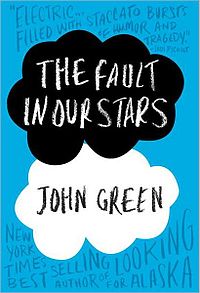
The Fault in Our Stars

Courtesy of Wikipedia
Author: John Green
Genre: Young Adult, Tragicomedy
Rating: A

"The fault, dear Brutus, is not in our stars, / But in ourselves, that we are underlings."

This book should come with a warning label. When you read the first couple pages or the back of the cover it makes you think that it's going to be this dark comedy about kids with cancer. Maybe even a bit romantic, but not overly depressing. It has a very "I'm a normal person despite my cancer" feel to it at first - I mean, heck, protagonist Hazel Grace Lancaster complains about missing an America's Next Top Model marathon in order to go to her support group in almost the first chapter (possibly even the first chapter). This book sucks you in and makes you think it's going to be light and funny and dark, only to completely fuck with you. The Fault in Our Stars should come with a warning label, so here it is: this is a book about kids with cancer. Books about kids with cancer are dark and depressing, no matter how light and humourous they might present themselves.

Hazel Grace Lancaster is a girl with cancer. She is sixteen and has been living with it for a long time now - and will continue to do so thanks to this magic, fictional drug that she's on. Weekly her parents force her to go to a support group for kids with cancer, where she meets the handsome and charming Augustus Waters. Gus is seventeen, in remission, and very smitten with Hazel. This is the story of them, and it you think it's going to end badly you'd be right.

There is a lot to Fault, at least in terms of the bask plot, that is predictable. You know they're going to fall in love, you know it's going to end tragically. I mean, the book is about kids with cancer and is named from a Shakespearean quote. There's no other way it could end. There's still mystery though - I spent half the book trying to guess which one of them would die, or if it would be both, or if it would be one and one of their friends, or a whole splatter of kids with cancer dying, or if one of the non-cancerous characters would die, or what. The boon itself isn't overly postmodern, but Hazel and Gus spend a lot of time discussing a book that, based on their descriptions, is postmodern, making you wonder if perhaps Fault is going to end like the fictional book within it - that is just stop mid sentence. I'm not going to tell you if it does or not, I'll let you suffer.

Despite being about kids this book is very adult. It meshes the adult world that its heroes have been forced into with the teenage world that they're clinging to amazingly well - alongside discussions of postmodernism and life and death they're also playing video games and reading ridiculous video game based novels and lamenting about heartbreak in a way that only teenagers can do. This is a depressing book, but it's also a light and funny one. It's complicated, but it's also very light.

A friend and I have this habit, however unintentionally, of recommending to each other the saddest and most depressing books that we've read. When I finished reading Fault and had wiped my tears away I instantly thought that I had to lend this book to her. If I spent half of it trying to guess what was going to happen and how it was going to end I spent the other half balling my eyes out. By the final chapters I was a mess of tears and snot, but I didn't want to put the book down long enough to blow m nose and dry my eyes because I had to know what was going to happen next. This book completely took hold of me and made my heart wrench. I felt as though I knew Hazel and August and had grown deeply attached to them. And really, that's exactly what a boom should be like.

Just a side note, the quote at the top if the page is from Act 1, Scene 2 of Julius Caesar, and is where Green got the title for the novel.

Monday, 17 September 2012

Outlander

Courtesy of Wikipedia
Author: Diana Gabaldon
Genre: Historical, Romance, Sci-Fi
Rating: A


The first in Diana Gabaldon’s series of the same name, Outlander tells the story of accidental time traveller Claire Randall and her journey through the eighteenth century Scottish Highlands on the eve of the 1745 Jacobite Rising.  I’ve read this book a number of times now, along with its successors, and I think this is easily the best in the series – although the sequels aren’t shabby either.

At the start of the novel former army nurse Claire Randall and her husband, Frank, are in Inverness, Scotland on a vacation to rekindle their marriage – no, not rekindle.  More renew; while there’s no doubt of the love between the two, they’ve been separated for a long time now as the result of the War, it being 1945 at the start of the book.  Then life drastically changes for Claire; during an excursion around the standing stones at Craigh na Dun Claire finds herself transported back 203 years in time, to 1742.  Claire quickly becomes captured by Clan MacKenzie and taken to Castle Leoch, and somewhat enchanted by the mysterious Jamie McTavish.  Overhanging all of this is Claire’s desire to return to her own time, and her husband, as well as the looming threat of war – which Claire, graced with the knowledge of the future, knows will be disastrous for Scotland.

I think this might be one of the few novels written in first person that I’ve ever really loved.  There’s something about Claire that makes it clear that even though she’s telling the story – and as such it’s biased by her perception of things – it’s clear that she’s still a flawed person.  A good number of the things that befall her and Jamie are caused by Claire’s own shortcomings and her failure to really fit into the world around her.  I love that Gabaldon took a woman who isn’t entirely modern and sent her back; I think it does a lot to help her fit into the eighteenth century while also making her accessibly to a contemporary reader.  She doesn’t spend her time fussing over things like central heating or running water – although she does lament the standard of personal hygiene common at the time – but she does have ideals that don’t exactly coincide with the way that the typical eighteenth century woman was expected to behave.  This becomes more prominent by Drums of Autumn, by which point it’s really clear that Claire’s place isn’t necessarily eighteenth or twentieth century, it’s at Jamie’s side.

As I believe I’ve said of other works of Gabaldon’s, Outlander is very anecdotal.  However, where it doesn’t seem to work as well in some of her short stories, it works really well in Outlander.  The overall issue of the plot is clear very early on – the woman from the twentieth century transported back to the eighteenth, on the eve of what is to be (for Scotland) a devastating war – and the incidents that happen following it do a lot to firmly establish the characters, the setting, and the time.  There is a bit of repetition to the story, particularly when it comes to Black Jack Randall, but it’s easy to forgive, especially at this early point in the series.  There’s also so much detail that it’s easy to get lost a bit at times, but for the most part it’s just enough to really emmurse yourself in the story.

My favourite part, though, is the dialects and accents. Gabaldon really has a nack for writing accents and dialects in a manner that’s easy to read. Her characters talk like people really talk, using words that firmly establish who they are and where they’re from. This is seen even more later on in the series, as more ethnicities are introduced, but for now it’s really easy to see that Claire Randall talks like an Englishwoman – not an American – and a good chunk of the rest of the characters talk like Scots.