Showing posts with label Tragicomedy. Show all posts

Monday, 22 October 2012

The Casual Vacancy

Courtesy of Wikipedia
Author: J.K. Rowling
Genre: Tragicomedy
Rating: B

When I was a teenager I stumbled across the comedic styling of George Carlin almost by accident.  I was flipping channels while waiting for the parents of the kids I was babysitting to come home, the kids having been put to bed, and I found this comedy special that caught my attention.  The entire time I was watching it I was trying to figure out where I knew the comic from, but I just couldn't place him.  Then, all of a sudden, he told me stating that he'd been Mr. Conductor and I realized that this man who had been cursing up a storm was from one of my favourite shows as a child, Shining Time Station.  It was really rather jarring.

I had a similar feeling in reading The Casual Vacancy, although I knew the entire time where I knew the author from.  Vacancy is so unlike the Harry Potter books that if you go into it expecting magic you'll be sourly disappointed.  I'm not sure how much I went into it expecting magic and how much I went in with no expectations. It did take me a while to really get into this novel and I was thoroughly shocked when topics and language that were so unlike the ones utilized in Harry Potter.  Perhaps I was expecting some magic.

The Casual Vacancy follows the little town of Pagford after the death of Parish Councillor Barry Fairbrother, particularly the many people affected in some way or another by Fairbrother's death.  The issue at hand, beyond the actual death, is the case of the Fields, a rundown and poor local estate that some town members wish to be rid off because of the way in which it degrades the reputation of the town.  Among the adult characters factions form between those who are in favour of the Fields, or simply want to honour Fairbrother's memory, and those who wish to be rid of it all.  The younger generation is no less divided, although somewhat less so on the issue of for or against the Fields.  Through its course, Vacancy covers the huge issues of class, politics, drugs, prostitution, rape, bullying, sex, sexuality, suicide, and race.

This book is immense, both in size and scope, and as such I found it really took a lot to get into.  The big problem of Vacancy is that there are so many characters and it's such a negative world that things seem really bleak and dark and ugly.  It wasn't until I was about half way through the novel that I realized I was hooked on it, and even further in that I realized that I was thoroughly attached to some of the characters.  Things had to really start going wrong for them before I realized I cared.  I think a big problem that this novel has is the comparison to Harry Potter, which is unfair to Rowling.  Vacancy may not have the magic of her previous series, nor even the joy of it, but it's still a wonder to read.  The style is different but the writing is still magnificent.  There are weak moments, as their are in Harry Potter, but I enjoyed it overall - once I realized that I was hooked on.

Monday, 1 October 2012

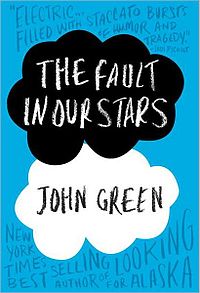
The Fault in Our Stars

Courtesy of Wikipedia
Author: John Green
Genre: Young Adult, Tragicomedy
Rating: A

"The fault, dear Brutus, is not in our stars, / But in ourselves, that we are underlings."

This book should come with a warning label. When you read the first couple pages or the back of the cover it makes you think that it's going to be this dark comedy about kids with cancer. Maybe even a bit romantic, but not overly depressing. It has a very "I'm a normal person despite my cancer" feel to it at first - I mean, heck, protagonist Hazel Grace Lancaster complains about missing an America's Next Top Model marathon in order to go to her support group in almost the first chapter (possibly even the first chapter). This book sucks you in and makes you think it's going to be light and funny and dark, only to completely fuck with you. The Fault in Our Stars should come with a warning label, so here it is: this is a book about kids with cancer. Books about kids with cancer are dark and depressing, no matter how light and humourous they might present themselves.

Hazel Grace Lancaster is a girl with cancer. She is sixteen and has been living with it for a long time now - and will continue to do so thanks to this magic, fictional drug that she's on. Weekly her parents force her to go to a support group for kids with cancer, where she meets the handsome and charming Augustus Waters. Gus is seventeen, in remission, and very smitten with Hazel. This is the story of them, and it you think it's going to end badly you'd be right.

There is a lot to Fault, at least in terms of the bask plot, that is predictable. You know they're going to fall in love, you know it's going to end tragically. I mean, the book is about kids with cancer and is named from a Shakespearean quote. There's no other way it could end. There's still mystery though - I spent half the book trying to guess which one of them would die, or if it would be both, or if it would be one and one of their friends, or a whole splatter of kids with cancer dying, or if one of the non-cancerous characters would die, or what. The boon itself isn't overly postmodern, but Hazel and Gus spend a lot of time discussing a book that, based on their descriptions, is postmodern, making you wonder if perhaps Fault is going to end like the fictional book within it - that is just stop mid sentence. I'm not going to tell you if it does or not, I'll let you suffer.

Despite being about kids this book is very adult. It meshes the adult world that its heroes have been forced into with the teenage world that they're clinging to amazingly well - alongside discussions of postmodernism and life and death they're also playing video games and reading ridiculous video game based novels and lamenting about heartbreak in a way that only teenagers can do. This is a depressing book, but it's also a light and funny one. It's complicated, but it's also very light.

A friend and I have this habit, however unintentionally, of recommending to each other the saddest and most depressing books that we've read. When I finished reading Fault and had wiped my tears away I instantly thought that I had to lend this book to her. If I spent half of it trying to guess what was going to happen and how it was going to end I spent the other half balling my eyes out. By the final chapters I was a mess of tears and snot, but I didn't want to put the book down long enough to blow m nose and dry my eyes because I had to know what was going to happen next. This book completely took hold of me and made my heart wrench. I felt as though I knew Hazel and August and had grown deeply attached to them. And really, that's exactly what a boom should be like.

Just a side note, the quote at the top if the page is from Act 1, Scene 2 of Julius Caesar, and is where Green got the title for the novel.