Showing posts with label Books. Show all posts

Monday, 28 January 2013

Madame Bovary

Author: Gustave Flaubert
Genre: Classic, Realism
Rating: B+

I wasn't a huge fan of Madam Bovary, for a number of reasons.  While I realize that it's classic literature and it's really well written, I found I really struggled in reading this novel.  On the one hand, I found a good chunk of it to be a bit boring - it's full of really elegant passages and there are moments that are really exciting, but for the most part it's all a bit dull and nothing seems to really happen.  I mean, yes, stuff happens, and yes there is this arch, but a lot of the time instead of showing me what's happening Flaubert instead simply tells me what's happened 

Madam Bovary follows the life of one Charles Bovary and his second wife, the young Emma.  Charles is a not too bright doctor in a provincial town of France who is madly in love with the idea of his wife and extremely devoted to her.  Emma is... well, Emma is basically a bitch who's read too much and as such has developed an idea of what love should be - and it's not what she has with her husband.  Love in her mind is only what it depicted in books and is full of grand gestures and what not. So, eventually, she decides to embark on an affair - and eventually her actions lead to ruin for all.

So, yeah.  Emma is not likeable. Charles is not likeable.  While you might feel bad for them both at various points in the novel - particularly in the end - you don't actually ever like them or even root for them.  The situation that they get themselves into is of their own doing and simply because they're both improperly educated (and aspiring to rise above their station in life, which was a no-no at the time), and because they don't communicate - also a no-no at the time.

The one thing that I did like about this book was the commentary that it makes on French life and French people.  I also enjoyed the commentary that it makes about relationships in general - one issue that was pointed out to me is just how the theme of communication is one that has come up time and time again in fiction surrounding relationships.  If people communicated better within Madam Bovary then the story would have a very different ending.  And maybe the characters would have been likeable.  That's actually the thing about this - there's no one here who I felt I should be rooting for.  I liked some of the more side characters, at least at times, but for the most part everyone sucked.  Except Justin, Justin was kind of great, but you knew he wasn't going to do well through the course of the novel - at least not until he escaped from everyone.

Monday, 21 January 2013

Crown and Country

Author: David Starkey
Genre: Non-Fiction, Historical
Rating: A-

This book could be divided into three parts, beginning, middle, and end, each part which is rather different and each part which I have different feelings about.  Throughout it, historian David Starkey describes the rise and falls (and there are many, many falls) of the men and women who have served as monarch of the nation that is now known as the United Kingdom of Great Britain and Northern Ireland.  Covering literally two thousand years of history Starkey traces the history of the monarchy, and the history of the nation itself, from its inception in the Celtic British period to the modern day Windsors.

The beginning part of this story, in my opinion, is the period of Britons, Anglo-Saxons, and Danes, ending with the death of Harold Godwinson and the Norman invasion.  William the Conqueror starts the middle section, and it continues on through the Normans, into the Plantagenets, and its cadet branches the Lancasters and Yorks, and ending with the rise of the House of Tudor.  The final part starts with the children of Henry VIII, Edward, Mary, and Elizabeth, and the Nine Days Queen, Jane, and continues through the Stuarts, Hanovers, the short-lived Saxe-Coburg and Gothas, and the current Windsors.  While each part is in itself extremely interesting and well linked - both with the contents of itself, and with the overall arch of the story it's telling - the way they're handled is somewhat different.  You can tell that Starkey prefers what I'm calling his middle part to the other points in British history, simply by the amount of detail that he uses when discussing the Normans, Plantagenets, and the first Tudors.  The bulk of the book is in itself a glance at the Kings and Queens of Britain and the making of the monarchy, but somehow it feels as though there is more detail to the stories of some of the earlier monarchs than there is in the later monarchs, or at least more of an attempt.  Obviously there is considerably less in regards to the Britons or the early Anglo-Saxons, who existed in a largely unrecorded period, but following the rise of Wessex and the subsequent rise of the Normans the amount of detail grows and it feels as though Starkey is really interested in what he's writing about.  Then, suddenly the amount of detail begins to drop and his interest appears to wane.

This can be seen just through the division of the chapters.  No monarch gets their own chapter in "Part I  - Beginnings," although for a good portion of this section the reigns are short and factual knowledge is limited - and it should be noted Edward the Confessor and Harold Godwinson, the latter whom had a very short reign, don't share their chapter with any earlier monarchs.  Each of the Norman kings gets his own chapter, as do the early Plantagenet kings - yes, Stephen and Matilda share one, but in a way they also share a reign.  Things move quicker with the later Plantagenets, particularly as the War of the Roses comes into force, but once again this kind of makes sense - the Richards, Henrys, and Edwards all kind of go together in terms of their historical greatness.  Where Starkey kind of loses me, however, is in giving Henry VIII his own chapter (deserving), but then dividing the reign of Elizabeth I into two, to be shared in a chapter with her siblings (no special chapter header for Jane Grey) first, and a shared chapter with her successor James VI & I and his son Charles I.  The reign of Elizabeth I is kind of a big deal - so big, in fact, that the era was named after it.  It is one of those reigns that kind of deserves its own chapter.  Likewise, Victoria deserves her own chapter, if only because of the length of her reign.  Dividing into two and wedging it into chapters that deal first with her uncles, George IV and William IV, and then with her son, grandson, and great-grandsons, in order Edward VII, George V, Edward VIII, and George VI, does not do her justice.

Nor, for that matter, does the whole way that he treats the 20th century (or several other centuries for that matter).  The closer to the present day the more the the reigns seem to be a bit squished together, the more the story becomes rather rushed.  Events like the two World Wars, the Jacobite Risings, Napoleon, the Abdication Crisis, etc, are all kind of glanced over.  There's also the idea of the Hanoverian monarchs having poor relationships with their parents, or conversely their eldest children. While Starkey touches on it he seems to be unaware of it at times - even going so far as to inaccurately say that the relationship between Prince Philip and Prince Charles shows the resumption of this Hanover tradition for the first time in three generations - it's not, not at all.  While there was a good relationship between George VI and Elizabeth II, the relationship between brothers Edward VIII and George VI with their father, George V, was at best less than stellar.  Likewise, while the relationship between George V and his father, Edward VII, was great, he was the younger brother, his elder brother, Prince Albert Victor, having had a very bad relationship with the King.  This trend continues too; Edward VII and his father, Prince Albert; Victoria and her mother the Duchess of Kent; George IV and George III; George II and George I... it continues.

The one thing that I really want to give Starkey credit for is the fact that while this book is very much historical, Starkey uses a narrative approach to make it interesting and appealing.  It was really great.  I also really enjoyed how he addressed and made reference to the different myths and legends that have been attached to the monarchs he's discussing, like the means of the death of Edward II.  I actually kind of want to re-read this book just so that I can take note of every time homosexuality, homoeroticism, etc, comes up.  It's actually a lot more than one might expect.  I also wouldn't mind re-reading to take extra note of ever usurping, rebellion, revolt, civil war, revolution, etc.  It's actually a lot more than one would think - in all honesty, going into this, I knew of the Norman Conquest, the struggles between Stephen and Matilda, the back-and-forth between Henry VI and Edward IV, and the subsequent usurpers Richard III and Henry VII, the Civil War and rise of Cromwell, and then of course the banishing of James II.  In a lot of ways, though, that's only the tip of the iceberg; there's so much more to it all.

Monday, 14 January 2013

Harry Potter and the Half-Blood Prince

Author: J.K. Rowling
Genre: Fantasy
Rating: A

Okay, so this is my favourite of the Harry Potter books.  I love the story within it, the way that the it plays out and the way that things relate to the overall series.  I love the idea of Harry finally becoming good at potions, like his mother before hand, even with the aid of a book (I also love the idea of him working with the aid of a book and Hermione frowning upon it).  The horcruxes are awesome as is the back story of Voldemort that we're given here, and the relationship between Harry and Dumbledore is further developed. Oh! And love is in the air, as the canonical pairings become very clear here.

It's year six at Hogwarts, and Harry's back and taking private lessons from Dumbledore himself with the aim of learning how to defeat Voldemort.  Harry's also captain of the Quidditch team, the favourite student of new potions professor, Horace Slughorn, and increasingly attracted to his best friend's younger sister, Ginny.  It's all great.  Oh, except for one thing: someone keeps on attacking students, and no one's sure who or how to stop it - although Harry is rather determined that the culprit is none other than Draco Malfoy.

The one bad thing about this book is Harry's obsession with Draco throughout it.  Very quickly on, Harry begins to annoy his friends by obsessing over what Draco's up to, and it doesn't take long for him to begin to annoy me with it as well.  Regardless of whether or not Draco is actually up to something (no spoilers), Harry's obsession is still annoying.

That being said, I absolutely loved the rest of the book.  The backstory, the pensive, the horcruxes, the consequences that it has for the rest of the series - the implications that it has for the things that happened before.  Love it all.  The fact that we get to really see why Harry is the Chosen one and what it all means and now what he's going to do with it is great.  The fact that people area actually supporting him through this, even though they don't all necessarily know as much as he does is also great.  Plus Harry and Ginny! I love them together, and I love how we got to see more of her in this book, although I do have to say it wasn't enough.  It's never enough - Ginny's probably my favourite character, and I always want more of her.

Monday, 7 January 2013

Men at Arms

Author: Terry Pratchett
Genre: Comedy, Fantasy
Rating: A

I think the City Watch books are, in all honesty, my favourite of the Discworld novels.   The characters are just great, possibly the best of the Discworld universe, although I'm sure I'll say differently next time I read a Witches or Rincewind book.

Murder is afoul at the great city of Ankh-Morpork and the City Watch is on the job - sort of.  Assassin Edward d'Eath, of the down-and-out noble d'Eath family, has become convinced that his family's humbling has been the result of the social change in the city, owing to the lack of a monarch on the throne.  It is his plan to restore the monarchy, and for this he needs the Disc's one and only firearm, the gonne.  The gonne, however, has a mind of its own and leaves behind it a trail of bodies.  Captain Vimes of the Night's Watch is on the case; investigating the disappearance of a mysterious item from the Assassin's Guild and a subsequent string of apparently unrelated but equally gruesome murders, all against the express orders of the city's Patrician, Havelock Vetinari.  Vimes' investigation is meant to be short lived, however, as he is due to retire with his impending nuptials to Lady Sybil Ramkin.  Also at hand is the rise in the Watch's ranks, as the Patrician has ordered that the Watch have ethnic recruits, in the form of a dwarf, troll, and female werewolf.

There are so many elements to this novel, all of which are great.  There's the obligatory Death appearance, awesome as always, and the Patrician, who might be my second favourite character in the series - behind Death, of course.  I love the way that the Patrician's mind works, the way he rules his City, and the way he interacts with others - especially Vimes.  I love Vimes too, and Carrot, and the way that they're both simple and complex at the same time.  The whole "Carrot is the true heir to the throne" thing is absolutely great and I enjoy seeing how it plays out.  I also enjoyed seeing the way that the relationship between Carrot and the new werewolf recruit, Angua, has begun to play out.  It's another element to Carrot, and I love their being more elements to Carrot.

The great theme of the book is the idea that "guns don't kill people, people kill people," and the fact that in the Discworld it is the gun, or gonne, that is behind the killings - to an extent.  While I'm not really a believer of the whole "guns kill people" I like the way that Pratchette worked this theme.  It might not work as well here, in the Roundworld, where guns do not have the ability to think and shoot people of their own accord, but it does work well in Discworld where that is far from being the weirdest thing to occur.  I really liked the way that it played out here.

Monday, 31 December 2012

The Captive of Kensington Palace

Author: Jean Plaidy
Genre: Historical
Rating: C+

The Captive of Kensington Palace is the first in historical fiction author Jean Plaidy's Queen Victoria series and follows the life of the future Queen in the years of her childhood, primarily during the reign of her uncle King William IV - the book picks up shortly before the death of George IV and ends with the death of William IV.  Following a number of characters, but centred entirely around Victoria, it shows the conflicts between the English house of Hanover and the German house of Saxe-Coburg and Gothas which compete over control of Victoria - on one side is her long deceased father's family, and the uncles through which she will inherit the United Kingdom of Great Britain and Ireland, and on the other side is her ever present and rather domineering mother and her mother's rather ambitious comptroller Sir John Conroy.

The thing that both makes this an exemplary work of historical fiction while also seriously disabling the book is Plaidy's adherence to history.  Often historical fiction looks at events from the perspective of fictional characters, created for the purpose of giving the author some creative licence, but Plaidy's works (both in regards to Captive and her many other books) instead look at things through the eyes of the real people during the real events.  She relies heavily on the use of non-fiction sources and primary sources - in this case including the letters and diaries of Victoria, passages of which are outright quoted here.   In a way, I really love it because it gives you such a strong sense of what actually happened, but at the same time it kind of makes the story itself a bit jilted and repetitive.  Peoples day-to-day lives tend to not be all that interesting, even when they're royalty, and can be rather repetitive, as we see in this work.  The problems that continually rise up, and the conversations (and arguments) that happen all just repeat the same things over and over again - Victoria will be Queen one day, William IV is like his father and destined for the straight jacket, the Duke of Cumberland wants to do away with Victoria although he will take the kingdom of Hanover as second place, the Duchess of Kent and Sir John want to control Victoria and fear the influence of the King and his wife, the King has no legitimate children and his wife is rather plain, but they're both in love.... it goes on like that.

The other problem with this book, and its follow up The Queen and Lord M, is that Victoria is very young and naive here, and as such her voice gets rather annoying after awhile. I found myself wanting to yell at her half the time, and tell her to learn about the position she is about to have thrust upon her - or even better, to yell at William IV or the Duchess of Kent for allowing Victoria to remain so uneducated on the matter.  In the case of the Duchess I really got it - an educated Victoria was a Victoria she could not control - but it pissed me off in regards to William IV, who did not want his heir controlled by the Duchess.  But then, that was the way history worked out here, so I can't really fault Plaidy, can I?  Overall, not Plaidy's best work, but still enjoyable.

Dark Lover

Author: J.R. Ward
Genre: Paranormal, Romance, Erotic Fiction
Rating: B

 Wrath is the King of the Vampires, known as the Blind King, but hasn't really embraced his title.  Then, one day his long time friend and brother in arms Darius asks Wrath to help his daughter, Beth, through her transition to vampire, shortly before being killed by a lesser - the vampires enemies.  Wrath then takes it upon him to help Beth, before slowly coming to realize that it is not enough to fight the lessers with his brothers, he must also lead his people.

There are a few things that should be noted here.  One is that while Dark Lover is not the best book in J.R. Ward's The Black Dagger Brotherhood series it is the one that opens us up to the world within which the series is set - and what an interesting world that is.  The second is that Ward's vampires here are really very different from other vampires, eliminating a lot of the things that really make them a threat to humans - and really removing them from the world of humans.  The third is that these books are to a degree formulaic and once you figure out the formula the ultimate ending to things becomes clear - not that you're not goign to be apprehensive and crying at some point before hand.

This book is fun.  The vampires are awesome, and really love how Ward goes back and forth between a number of different perspectives - telling the story of both the book's core relationship and things that are going on in the periphery.  I really liked the humans in this book too, although I was a bit disappointed to see that with the exception of Beth and Butch they disappear in the later books.  My favourite part, though, is that the vampires are just so different from any other vampires I've ever seen before. I love when I'm reading a fantasy book that seems to be inspired by other fantasy books but are also different and strike out on their own.  The problem that I have with some books is that their authors so clearly don't enjoy reading the genre in which they write, which is something that I never felt in Dark Lover.  It's a good, engrossing, quick read.  Perhaps a bit smutty or trashy, but still fun.

Monday, 24 December 2012

Drums of Autumn

Author: Diana Gabaldon
Genre: Historical, Romance, Sci-Fi
Rating: A-

The fourth instalment in the Outlander series, Drums of Autumn takes our heroes Claire and Jamie Fraser to the American colonies just before the American Revolution.  While Claire knows what is going to happen she's not certain an all the details and knows that she and her family must walk a thin line so as to survive the Revolution with their lives intact.  Newcomers to the land, the Frasers must establish themselves and Jamie dreams of gathering up the men that he was in prison with.  Meanwhile, in the mid-20th century their daughter Brianna is coming to terms with now essentially being an orphan, having lost her mother and the father that she has only just learned of.  In order to come to terms with this, Brianna and the historian Roger Wakefield seek out information about Claire and Jamie, with the hope of discovering what happens to them.

The question that I always have here is just why Claire and Jamie decide to settle in America, at least knowing what they know.  Regardless of their allegiance to the British crown (which does exist for Claire if not her husband), being somewhere largely unaffected by the war just seems kind of safer and in the long run smarter.  Once they commit to making life work in America I get why they chose to stay, but I always wonder why they decided to make that commitment in the first place.  I don't even buy that Jamie wouldn't have had friends or family in Canada to help him establish himself - Jamie seems to have friends or family just about everywhere he goes.

That being said, I did like the general story of Drums.  Things get a lot more complicated in this part of the series than they ever seemed to be in the first two (or three) books, but it's an enjoyable complicated.  I am never too sure about Brianna and Roger as characters, and even less so as time travellers.  Claire seems to have fit in both the 18th and the 20th century, while Brianna and Roger seem to only fit in the 20th, despite their travelling to the 18th (and Jamie, who is stationary in time, doesn't seem as though he would fit in the 20th, although if given the opportunity and need I have no doubt that he would make it work if it meant being with Claire).  I do like the overarching villain of Stephen Bonnett, though, and find the threat that he adds to things to be really interesting.  I grew to kind of hate Geillis in the earlier books, and not in a good way, so I was glad to see that they were really done with her and had moved on to a new threat - or to at least be given that feeling.

Monday, 17 December 2012

Harry Potter and the Order of the Phoenix

Author: J.K. Rowling
Genre: Fantasy
Rating: B

Following the disastrous results of the Triwizard Tournament, Harry Potter was sent back to his Muggle aunt and uncle's home.  All summer he waited anxiously for news of Voldemort's return, growing more and more desperate and aggravated as the days passed by and he began to feel more and more shut out of the wizarding world.  Then Dementors arrive and attack him and his cousin.  Suddenly, Harry is faces being expelled from Hogwarts, forced to face a trial at the Ministry of Magic, and it is revealed that few in the Magical world believe him anymore.  Those who do believe him, and Dumbledore, are in the Order of the Phoenix, a secret organization that operates against Voldemort.  While Harry is able to successfully avoid expulsion and prison, things are not as they used to be at Hogwarts.  He is the subject of gossip and disdain from his peers, and is in constant opposition with the new professor of Defense against the Dark Arts, Dolores Umbridge, a woman who is clearly working for Minister of Magic Cornelius Fudge against Dumbledore.

There are elements of this book that are absolutely awesome.  I love the Order, Dumbledore's Army, Kreacher, the emergence of Weasley's Wizard Wheezes.  There are so many really great aspects of this novel, that just add to the world of Harry Potter and make it even better.  Really in the long run, Harry Potter and the Order of the Phoenix is great because of everything in it that isn't Harry himself.  I think my favourite elements of this book are actually the DA and the growth of Neville Longbottom.  This is the book where the secondary characters really start to take form of their own and exist beyond the mind of Harry Potter.  We've seen how Harry, Ron, and Hermione have been growing all along, but we haven't seen how Neville, Ginny, etc, have been doing so - Order of the Phoenix shows us this through the furthered interactions that Harry has with the Weasleys and the development of the DA.  We also really get to see this calling for teaching that Harry has.  He gets to show others how to do the things that he can do - he gets to expand their knowledge base and in doing so he also expands his knowledge base.  Oh, plus, as much as I hate Umbridge her constant presence places this huge amount of strain on Harry throughout the year, and thus throughout the book, ensuring that the plot is always present.  Voldemort is in many ways a rather secondary threat here, Umbridge is the big focus.  In a manner, it kind of reminds me of the Little and Big Bads of the Buffyverse.  Umbridge is definitely the Little Bad, but she gains more of a focus throughout the course of the book.

The thing that I really disliked about this book, which rather disables it as a whole, is Harry.  As much as I understand what he's going through, this is the book where he really becomes a whiny, annoying teenager.  It makes it hard to like him.  There's a point in the book where I found myself wishing that it was being told from a different perspective, because I didn't care about Harry's self-sacrificing, self-hating, hating the world, attitude.  There are moments when it's great - like when he locks himself in his room out of fear that he's the weapon being used by Voldemort - but for the most part it is less than great.  We're often told that the greatest power that Harry has is his ability to love, but in this book all we see is hate.  He hates others, he hates himself, others hate him... It's a very ugly mess and given just how long the book is makes things a bit dull after awhile.

Monday, 10 December 2012

Drive

Author: James Sallis
Genre: Neo Noir
Rating: A-

"Much later, as he sat with his back against an inside wall of a Motel 6 just north of Phoenix, watching the pool of blood lap toward him, Driver would wonder whether he had made a terrible mistake."

It's kind of a rule of book-to-movie adaptations that the book is always better than the movie.  Like every rule, there are always the exceptions to it, and James Sallis' Drive, which inspired the movie of the same name, is one of those exceptions.  That's not to say that this book isn't good, great even, just that I think the movie was better.

Drive is about a man, Driver, who works as a stunt driver during the day and a get-away car driver during the night.  Life is good, albeit a bit unstable, until he takes a job that goes horribly wrong.  During it Driver is double crossed, and following it he decides to go after those who did the double crossing and are out to kill him.  The story is told in an anachronistic fashion, going back and forth between Driver's actions following the double crossing and his life leading up to it, and follows not only Driver but to a lesser extent the lives of those around him.

In a lot of ways, the plot of Drive the book is a lot better than the plot of Drive the movie.  It isn't a love story, it isn't an action story, it's just a nitty gritty, dark book.  It isn't trying to appeal to this vast audience, which is in my opinion what makes it a real gem.  It's written not for the money that it can make or the attention that it can draw, but for the pure pleasure of writing. We get the background of the characters - Driver, Nico, Benie Rose.  We get to understand why things happen the way they happen.

What doesn't work as well is the anachronistic ordering of the book, and the way that it appears to be a bit unsure of the tense that it wants to be written in.  There were a few points when I wasn't sure if the book was being written in present or past tense or both, in a way that was really rather aggravating.  The way that it switched around with the narration and point of view was also aggravating - a lot of the time it wasn't bad, but there were times when it took me a bit to figure out just whose part of the story was being told.  I don't mind having to think when I'm reading - I enjoy it really - but I do dislike being deliberately confused by the author.  It's one thing when it's a misleading plot, it's another thing when it's more the case of sloppy writing and a lack of personal pronouns.  When your characters are primarily male then "he" doesn't cut it as an identifier.

I did really like the way this book ended, however, and the plot differences between it and and the movie.  The movie really tries to be a love story and sets up a lot of Driver's actions as the result of this.  In the book, however, the relationship between him and the girl is far from being the focus, which I liked.  Love stories are great, but not everything is a love story, which Sallis seems to get.

Monday, 26 November 2012

Voyager

Author: Diana Gabaldon
Genre: Historical, Romance, Sci-Fi
Rating: B-

The third novel in Diana Gabaldon's critically acclaimed Outlander series, I have to say that I think that Voyager is probably the weakest, at least in so far as her novels go.  While there is a story here a lot of it seems to be more about a justification of her desire to reunite protagonists Jamie and Claire and move them, once again, towards the action.  While I appreciate the sentiment and I do largely agree with the desire to reunite our time traveller with her soul mate, there is still a big part of me that can't help but feel as though more so than most of Gabaldon's books, Voyager really fails to stand out on its own and really serves instead as a bridge covering the cap between two separate parts of the series.

Voyager picks up where its predecessor, Dragonfly in Amber, left off, with Claire facing the revelation that Jamie is not dead, as she had long believed, but rather very much alive - or at least, would be, 200 years in the past.  Time travel inherently makes understanding things like that more complicated.  Claire sets out on a journey to reunited with her man, while the daughter that she is leaving behind, Brianna, comes to terms with the knowledge that the man she thought was her father wasn't, and that she's now about to lose the only parent that she has left.  Meanwhile, Roger Wakefield is faced with the very pressing desire to be a big part of Brianna's life.

I already said this, but I think it bares repeating.  This book is a bridge between two connected but rather separate stories; Outlander and Dragonfly are about Scotland and the Rising, while the later novels are about America and the revolution.  This book serves to connect the two and to establish the younger generation.  While Jamie and Claire continue to play important roles in these books, in a manner of speaking they also become more and more about Brianna, Roger, Young Ian, and other characters more their age.  I understand that, and I really respect that, although I do think that in later books the series becomes a bit bogged down by both the characters and the number of different plots going on.  Gabaldon is a great writer, but sometimes it becomes a bit much and at points it begins to lose the charm of Outlander.

The other problem with Voyager is that in being a bridge book the plot is somewhat lacking.  There's a lot of set up here for a major future plot device, and likewise there's a lot of conclusion here for some of the hanging threads of previous devices.  In as much as the characters might at times bog down later books, one of the things that I love about Gabaldon in general is the plethora of really deep and unique characters.  Voyager doesn't lack in them at all, but for much of the time it almost seems like they're there not so much to introduce or partake in any plot, but to simply exist.  In a way this works, but in a way it doesn't.  The way that it really doesn't work, at least for me, is the fact that there is almost no continuity in these characters - the bulk of them were never introduced before Voyager and do not appear again afterwards.  This is really hugely disappointing, just because I like to see the ways in which these characters appear to have developed off screen.  This idea continues as well; a lot of the characters introduced in Outlander and Dragonfly no longer appear to exist in Voyager.  While it's understandable that Claire has been gone (and presumed dead) for some twenty years, there's still a part of me that wants to see her seek out some of her old companions.  She might not wonder what happened to them, but I do.

Monday, 19 November 2012

Harry Potter and the Goblet of Fire

Courtesy of Wikipedia
Author: J.K. Rowling
Genre: Fantasy
Rating: A

New adventures are coming to Hogwarts, just in time for Harry Potter’s fourth year.  The school is playing host to the Triwizard’s Tournament, a competition between champions representing the three great European schools of magic, Hogwarts, Beauxbatons, and Durmstrang, as determined by the Goblet of Fire.  Traditionally there are only three champions, one for each of the schools, and with the revival of the championship a new rule has been introduced stating that no one under the age of seventeen may enter their name as a champion.  This is all changed, however, when four names come out of the Goblet; Cedric Diggory, Fleur Delacour, Viktor Krum, and Harry Potter.  At first, only Hogwart’s new Defence Against the Dark Arts Teacher, ex-Auror and extremely paranoid Alastor “Mad-Eye” Moody, and Albus Dumbledore seem to believe that Harry did not put his name into the goblet and the school is divided between those few who support Harry, and are primarily Gryffindors, and those who think he is attempting to steal the glory from Hufflepuff Diggory.  As Harry begins to face his challenges one begins to wonder just who has a desire to hurt Harry.

Harry Potter and the Goblet of Fire is the book where Rowling really succeeds in quickly introducing the main plot of the story and staying with it throughout the entire novel.  The first chapter sets things up really nicely and the events that happen to Harry during his summer each have an effect on things that happen once school starts up again.  The storytelling here is becoming a lot more concise, ironically while also becoming longer.  The fourth book is almost as long as the first three books combined, and by series end is the second longest book.  The way this works out in Goblet of Fire is that the first overt sign of the complexity of the world of Harry Potter.  There have been other smaller signs of it previously – the first example being the deluminator in the first chapter of Harry Potter and the Philosopher’s Stone, the second being the casual reference to Sirius Black and the less casual reference to his flying motorcycle.  The story here is a lot more concise than the earlier books, but there’s also a lot more going on and we really get to see the world in a whole new light.  We’re introduced to the idea of a magical world beyond just Great Britain, meeting out first international wizards.  We also get to see Harry watch Quidditch for the first, and really the only, time.

In addition to the size of the book, the reader of the book also grows here.  While previous books all had their dark elements, it isn’t until Goblet of Fire that this begins to become really serious.  We see our first deaths of the series – not including the deaths of Harry’s parents, which we’ve been told about and sort of seen briefly before, but not in its entirety.  With the death of Frank Bryce in the first chapter of the book Rowling shows us that she’s not messing around, a fact that she really continues to emphasis throughout both this book and the later ones.  An idea that is introduced in the previous book, Harry Potter and the Prisoner of Azkaban, is really reinforced here, namely the idea of Voldemort’s followers, the Death Eaters, and the fact that they’re not all imprisoned.  We’ve known for awhile that the world is not just happy go lucky and there are bad people here, but somehow the presence of the Death Eaters really reinforces that idea.  We’re also really shown that the world is not divided into good people and Death Eaters.  While we’ve already met a number of people who might later be put into the category of “not good” without falling into the category of “Death Eater,” this is the first time that it’s made explicit.  Rita Skeeter is by no means a good person, but she’s also not a Death Eater.  In contrast, Barty Crouch Sr. is far from being a Death Eater, but one might also question if he’s exactly a good person, and that’s without going into the whole issue of Ludo Bagman, or some of the other characters introduced here.

One criticism about the book, however, lies within its complexity.  There is a lot that could have happened and would have made more logical sense to have happened.  I love the tournament in general, but Voldemort’s plan in this novel has far too many possibilities for failure and if you think about things too closely it makes you question just why he went with it in the first place.   Yes, there’s the whole idea of “I must kill Harry Potter” and what not, but there are a lot of ways that he could have taken Potter without the more elaborate plot, with a lot more fail safes built into it.  The book itself is based on something that really makes no sense, but… well, it’s still a good story.  Maybe not my favourite in the series, but I still love it.

Monday, 12 November 2012

Harry Potter and the Prisoner of Azkaban

Author: J.K. Rowling
Genre: Fantasy
Rating: B+

It’s back to Hogwarts, and as Harry and his friends return for their third year.  As is customary in these books, both the reader and Harry are introduced to greater elements of the wizarding world, in this case the magic world beyond just London and Hogwarts.  Just before Harry returns to school there is an unprecedented breakout at the wizard’s prison, Azkaban, and the deranged madman Sirius Black is on the loose – and looking for Harry Potter.  In the hunt for Black the guards of Azkaban are let loose, and Dementors come to Hogwarts.

One of the things that I loved most about this book was the fact that it broke down the previous conceptions of the divisions within Hogwarts.  Previously it’s been depicted that good people are not in Slytherin and the best people are in Gryffindor, but here we’re being shown a different perspective of things.  Not all Gryffindors are good, therefore presumably not all Slytherins are bad.  This theme really become ones that captures the series; divisions among peoples and yet the ways that we must also come together.  I love, love, love, love this theme and the ways in which it pops up throughout the series.  Previously, even the more mischievous of Gryffindors have been inherently good, while all the Slytherins we know are bullies.

The title of this book, however, is somewhat misleading. While the crux of the climax is in fact about the Prisoner of Azkaban, the book itself is more about fear and a manifestation of fear itself, the Dementors. I think the book could have easily been titled Harry Potter and the Dementors of Azkaban, although the use of two new words might have been a bit too much – with the word “Prisoner” and the similarity between the words “Azkaban” and “Alcatraz” we can assume that the one is some sort of jail. Point is, this book is more about Dementors and what they represent – both for Harry and the world around him – than Sirius Black and the threat he poses, although that is an important part of the overall story of the series. I really like what the Dementors say about the wizarding world. They pose this very real threat to humans in general, as their presence sucks the joy out of a person and can drive them insane and their kiss can suck the soul out of a human – here Rowling tries to answer the question “what’s worse than death.” They represent fear in itself, but the question that people don’t necessarily think about when confronted with them – but I think Rowling is trying to raise – is what can you make of a government that utilizes such a force? And what happens when that government tries to stop using them, or worse when they stop using the government? This threat is far more enticing, and scary, than the Dementors themselves.

Monday, 22 October 2012

The Casual Vacancy

Courtesy of Wikipedia
Author: J.K. Rowling
Genre: Tragicomedy
Rating: B

When I was a teenager I stumbled across the comedic styling of George Carlin almost by accident.  I was flipping channels while waiting for the parents of the kids I was babysitting to come home, the kids having been put to bed, and I found this comedy special that caught my attention.  The entire time I was watching it I was trying to figure out where I knew the comic from, but I just couldn't place him.  Then, all of a sudden, he told me stating that he'd been Mr. Conductor and I realized that this man who had been cursing up a storm was from one of my favourite shows as a child, Shining Time Station.  It was really rather jarring.

I had a similar feeling in reading The Casual Vacancy, although I knew the entire time where I knew the author from.  Vacancy is so unlike the Harry Potter books that if you go into it expecting magic you'll be sourly disappointed.  I'm not sure how much I went into it expecting magic and how much I went in with no expectations. It did take me a while to really get into this novel and I was thoroughly shocked when topics and language that were so unlike the ones utilized in Harry Potter.  Perhaps I was expecting some magic.

The Casual Vacancy follows the little town of Pagford after the death of Parish Councillor Barry Fairbrother, particularly the many people affected in some way or another by Fairbrother's death.  The issue at hand, beyond the actual death, is the case of the Fields, a rundown and poor local estate that some town members wish to be rid off because of the way in which it degrades the reputation of the town.  Among the adult characters factions form between those who are in favour of the Fields, or simply want to honour Fairbrother's memory, and those who wish to be rid of it all.  The younger generation is no less divided, although somewhat less so on the issue of for or against the Fields.  Through its course, Vacancy covers the huge issues of class, politics, drugs, prostitution, rape, bullying, sex, sexuality, suicide, and race.

This book is immense, both in size and scope, and as such I found it really took a lot to get into.  The big problem of Vacancy is that there are so many characters and it's such a negative world that things seem really bleak and dark and ugly.  It wasn't until I was about half way through the novel that I realized I was hooked on it, and even further in that I realized that I was thoroughly attached to some of the characters.  Things had to really start going wrong for them before I realized I cared.  I think a big problem that this novel has is the comparison to Harry Potter, which is unfair to Rowling.  Vacancy may not have the magic of her previous series, nor even the joy of it, but it's still a wonder to read.  The style is different but the writing is still magnificent.  There are weak moments, as their are in Harry Potter, but I enjoyed it overall - once I realized that I was hooked on.

Monday, 15 October 2012

A Dragonfly in Amber

Author: Diana Gabaldon
Genre: Historical, Romance, Sci-Fi
Rating: B+


The sequel to Outlander, A Dragonfly in Amber is a bit more jumpy than its predecessor – particularly in the start and finish.  Rather than being a straight continuation of the story where it left off, Dragonfly jumps to the future – thus establishing that Claire both survives the rising and returns to the future, while leaving the how, why, and (most importantly) what happens to Jamie left hanging.  I think a big part of the reason why Dragonfly isn’t as strong as Outlander is because of this immediate jump to the ‘future’; it’s a bit disjaring (which is okay, given the nature of the series), but more significantly it kind of interrupts the story.  Outlander is one concise story, about a woman out of time, with the reader experiencing things as she’s experiencing them (despite the novel being written in the past tense).  By starting Dragonfly twenty (and 203) years after the events of Outlander Gabaldon is establishing Claire as this older, wiser woman now telling a story to her daughter – and, frankly, some of the story that she tells the readers is stuff that I would hope she isn’t also telling Brianna.  The story that Claire tells Brianna and Roger is one that picks up very roughly where Outlander ends and brings our English woman and Scotsman into France on the eve of the 1745 Rising. Knowing what they know about the future, Claire and Jamie are faced with a problem: can they use what they know to change the future and if so, should they be trying to prevent the Rising or work to make it successful?

I really like the way this book ends, even if I wasn’t a big fan of the way in which it was started.  Honestly, I love the idea of a narrator telling us a story from a much older perspective, as they look back on their life.  It’s actually a big part of why I enjoy Bernard Cornwell's The Warlord Chronicles and The Saxon Stories.  As I said, the problem that I had with the way Dragonfly did this was that it interrupted the overall narration of the story.  I think I would have rather seen the jump forward twenty years to a Claire telling the story to Brianna and Roger at the end; have her in the present with her daughter be the big reveal at the end instead of the shock at the start.  But that’s all coulda, woulda, shoulda, and while I’m not a big fan of how Gabaldon did this overall I do have to admit it works.

That being said, what I don’t think worked as well was the period of the novel where our heroes are in France.  While I loved the characters that are introduced here – especially Master Raymond – and would love to see some of them remerge in later books, the overall story here in itself was a bit on the dull side.  The charm of Outlander was its setting, but the bulk of Dragonfly is really removed from this setting.  Claire was a fish out of water to begin with, but while in France it’s more like she’s… I donno… a whale out of water.  She’s able to survive, but not for long – likewise with my attention span.

One of the things that I do love, however, is the introduction of Roger as a narrator, even if it is in the third person. I really like the way Roger sees things. Like myself he’s a historian who’s intrigued by a good tale, and it’s made very clear very quickly that the only way Claire is able to move forward and Brianna is able to accept the truth is through Roger. The part of me that enjoys a good mind fuck in literature almost thinks that it’d be fun if Claire was revealed to have been a complete nutjob who dreamed her time in the eighteenth century, but I realize that’s not going to happen – there’s too much pseudo-science to these books to make them just a mind fuck.

Monday, 8 October 2012

Death of Kings

Courtesy of Goodreads
Author: Bernard Cornwell
Genre: Historical Fiction
Rating: B

Alfred the Great is dying, and the kingdom that he has spent his life building is poised to be torn apart by his many rivals.  Enter Uhtred of Bebbanburg, Alfred's semi-tamed pagan warrior, who is in love with Alfred's daughter and has grown to share Alfred's dream of a united England.

I love the journey that Uhtred has taken in this series, and Death of Kings shows him finally beginning to be recognized for all he has done.  To me that's always been the most infuriating thing about this series: every time Uhtred accomplishes something he's very completely pushed back down into his place.  I don't think a post-Alfred Wessex will be all that much more forgiving of Uhtred's pagan ways than the Alfredian Wessex, but at the same time I know the history and I know the tide's about to really turn for the Anglo-Saxons in the war against the Danes.  I know it's only a matter of time before Uhtred really gets the recognition he deserves from the king that he so resentfully acknowledges and yet loyally defends, and this novel shows the start of that recognition.  My favourite part of it all is the way in which Uhtred uses Lady Æthelflæd.   Their love has been one that's long in the development, and I love the nature that it's taken - especially as Uhtred doesn't change the way that he acts when she's not around.

The one thing that actually really annoyed me about this novel was the anachronastic language.  Previous books have always referred to the people using more time appropriate language; it wasn't the English, Welsh, and Scots fighting against the Danes so much as the Anglo-Saxons, Britons, and Picts, with references to the Gauls and the Celts.  This book speaks of Scotland and Wales, to my great disliking.  I really hope that it's just in my edition that this has happened, although I know better than to think that it is.  Having read a lot of Cornwell's works before, in particular the similarly timed and themed Warlord Chronicles I was especially disappointed by this switch just because it didn't seem like him.  It was a downside to an otherwise stellar book.

Monday, 1 October 2012

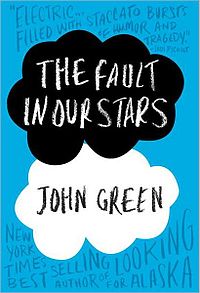
The Fault in Our Stars

Courtesy of Wikipedia
Author: John Green
Genre: Young Adult, Tragicomedy
Rating: A

"The fault, dear Brutus, is not in our stars, / But in ourselves, that we are underlings."

This book should come with a warning label. When you read the first couple pages or the back of the cover it makes you think that it's going to be this dark comedy about kids with cancer. Maybe even a bit romantic, but not overly depressing. It has a very "I'm a normal person despite my cancer" feel to it at first - I mean, heck, protagonist Hazel Grace Lancaster complains about missing an America's Next Top Model marathon in order to go to her support group in almost the first chapter (possibly even the first chapter). This book sucks you in and makes you think it's going to be light and funny and dark, only to completely fuck with you. The Fault in Our Stars should come with a warning label, so here it is: this is a book about kids with cancer. Books about kids with cancer are dark and depressing, no matter how light and humourous they might present themselves.

Hazel Grace Lancaster is a girl with cancer. She is sixteen and has been living with it for a long time now - and will continue to do so thanks to this magic, fictional drug that she's on. Weekly her parents force her to go to a support group for kids with cancer, where she meets the handsome and charming Augustus Waters. Gus is seventeen, in remission, and very smitten with Hazel. This is the story of them, and it you think it's going to end badly you'd be right.

There is a lot to Fault, at least in terms of the bask plot, that is predictable. You know they're going to fall in love, you know it's going to end tragically. I mean, the book is about kids with cancer and is named from a Shakespearean quote. There's no other way it could end. There's still mystery though - I spent half the book trying to guess which one of them would die, or if it would be both, or if it would be one and one of their friends, or a whole splatter of kids with cancer dying, or if one of the non-cancerous characters would die, or what. The boon itself isn't overly postmodern, but Hazel and Gus spend a lot of time discussing a book that, based on their descriptions, is postmodern, making you wonder if perhaps Fault is going to end like the fictional book within it - that is just stop mid sentence. I'm not going to tell you if it does or not, I'll let you suffer.

Despite being about kids this book is very adult. It meshes the adult world that its heroes have been forced into with the teenage world that they're clinging to amazingly well - alongside discussions of postmodernism and life and death they're also playing video games and reading ridiculous video game based novels and lamenting about heartbreak in a way that only teenagers can do. This is a depressing book, but it's also a light and funny one. It's complicated, but it's also very light.

A friend and I have this habit, however unintentionally, of recommending to each other the saddest and most depressing books that we've read. When I finished reading Fault and had wiped my tears away I instantly thought that I had to lend this book to her. If I spent half of it trying to guess what was going to happen and how it was going to end I spent the other half balling my eyes out. By the final chapters I was a mess of tears and snot, but I didn't want to put the book down long enough to blow m nose and dry my eyes because I had to know what was going to happen next. This book completely took hold of me and made my heart wrench. I felt as though I knew Hazel and August and had grown deeply attached to them. And really, that's exactly what a boom should be like.

Just a side note, the quote at the top if the page is from Act 1, Scene 2 of Julius Caesar, and is where Green got the title for the novel.

Harry Potter and the Chamber of Secrets

Author: J.K. Rowling
Genre: Fantasy
Rating: B

"The Chamber of Secrets has been opened. Enemies of the heir, beware."

Time to resume my love affair with J.K. Rowling’s bestselling Harry Potter novels, this time with the second book in the series Harry Potter and the Chamber of Secrets.  You may remember that in my review of Harry Potterand the Philosopher’s Stone I stated that I was unable to be unbiased in my review of the book.  That continues on with this review, possibly even more so as Chamber of Secrets is one of my favourite in the series.

It’s another year at Hogwarts and our favourite magical trio – Harry, Ron, and Hermione – are back for their second year of schooling.  This is possibly the most dangerous time of all at Hogwarts, however, as the legendary Chamber of Secrets has been opened and Slytherin’s monster has been unleashed on the school – and is attacking students.  Can they find the chamber and stop the monster before the school gets shut down or, worse, before someone is killed?

If the biggest flaw in Philosopher's Stoneis that it takes too long to really get to the point, then that is almost immediately solved  in Chamber of Secrets.  While there is still a bit of preamble, the plot itself is foreshadowed in an early at-the-Dursley's chapter with the appearance of the house elf Dobby (who is, in my opinion, one of the best characters introduced in this book), and the attacks begin following the Halloween chapter - which is relatively early on; the books each cover the course of approximately one year, starting typically around Harry's birthday at the end of July and continuing until the end of the school year in June.  Once again the book is very anecdotal, or at least appears so, but the story is a lot more cohesive than its predecessor.  There's far less opportunity for you to question where it's going or to get bored - not that you're likely to get bored with Philosopher's Stone- because there's more visible to the reader in this book. You still have all the questions about what's happening, but they're all relevant to the plot - what is the Chambe of Secrets, who is Slytherin's Heir and what is His monster?  Rather than question it for a few chapters near the end you get to question it for a lot longer.

The other thing that I really liked about this novel is how much it foreshadows for the greater series - more so, in my opinion, than its predecessor and even some of the following books.  Things that come up in Chamber of Secrets end up playing a far greater role in the overall series - some of them being so trivial that you overlook them when first introduced.  I'm not going to point them all out here because that's part of the fun of reading, and re-reading, the series; seeing all the little details that Rowling put in there that you missed before, or could only really notice in hindsight.