Showing posts with label Fantasy. Show all posts

Monday, 14 January 2013

Harry Potter and the Half-Blood Prince

Author: J.K. Rowling
Genre: Fantasy
Rating: A

Okay, so this is my favourite of the Harry Potter books.  I love the story within it, the way that the it plays out and the way that things relate to the overall series.  I love the idea of Harry finally becoming good at potions, like his mother before hand, even with the aid of a book (I also love the idea of him working with the aid of a book and Hermione frowning upon it).  The horcruxes are awesome as is the back story of Voldemort that we're given here, and the relationship between Harry and Dumbledore is further developed. Oh! And love is in the air, as the canonical pairings become very clear here.

It's year six at Hogwarts, and Harry's back and taking private lessons from Dumbledore himself with the aim of learning how to defeat Voldemort.  Harry's also captain of the Quidditch team, the favourite student of new potions professor, Horace Slughorn, and increasingly attracted to his best friend's younger sister, Ginny.  It's all great.  Oh, except for one thing: someone keeps on attacking students, and no one's sure who or how to stop it - although Harry is rather determined that the culprit is none other than Draco Malfoy.

The one bad thing about this book is Harry's obsession with Draco throughout it.  Very quickly on, Harry begins to annoy his friends by obsessing over what Draco's up to, and it doesn't take long for him to begin to annoy me with it as well.  Regardless of whether or not Draco is actually up to something (no spoilers), Harry's obsession is still annoying.

That being said, I absolutely loved the rest of the book.  The backstory, the pensive, the horcruxes, the consequences that it has for the rest of the series - the implications that it has for the things that happened before.  Love it all.  The fact that we get to really see why Harry is the Chosen one and what it all means and now what he's going to do with it is great.  The fact that people area actually supporting him through this, even though they don't all necessarily know as much as he does is also great.  Plus Harry and Ginny! I love them together, and I love how we got to see more of her in this book, although I do have to say it wasn't enough.  It's never enough - Ginny's probably my favourite character, and I always want more of her.

Monday, 7 January 2013

Men at Arms

Author: Terry Pratchett
Genre: Comedy, Fantasy
Rating: A

I think the City Watch books are, in all honesty, my favourite of the Discworld novels.   The characters are just great, possibly the best of the Discworld universe, although I'm sure I'll say differently next time I read a Witches or Rincewind book.

Murder is afoul at the great city of Ankh-Morpork and the City Watch is on the job - sort of.  Assassin Edward d'Eath, of the down-and-out noble d'Eath family, has become convinced that his family's humbling has been the result of the social change in the city, owing to the lack of a monarch on the throne.  It is his plan to restore the monarchy, and for this he needs the Disc's one and only firearm, the gonne.  The gonne, however, has a mind of its own and leaves behind it a trail of bodies.  Captain Vimes of the Night's Watch is on the case; investigating the disappearance of a mysterious item from the Assassin's Guild and a subsequent string of apparently unrelated but equally gruesome murders, all against the express orders of the city's Patrician, Havelock Vetinari.  Vimes' investigation is meant to be short lived, however, as he is due to retire with his impending nuptials to Lady Sybil Ramkin.  Also at hand is the rise in the Watch's ranks, as the Patrician has ordered that the Watch have ethnic recruits, in the form of a dwarf, troll, and female werewolf.

There are so many elements to this novel, all of which are great.  There's the obligatory Death appearance, awesome as always, and the Patrician, who might be my second favourite character in the series - behind Death, of course.  I love the way that the Patrician's mind works, the way he rules his City, and the way he interacts with others - especially Vimes.  I love Vimes too, and Carrot, and the way that they're both simple and complex at the same time.  The whole "Carrot is the true heir to the throne" thing is absolutely great and I enjoy seeing how it plays out.  I also enjoyed seeing the way that the relationship between Carrot and the new werewolf recruit, Angua, has begun to play out.  It's another element to Carrot, and I love their being more elements to Carrot.

The great theme of the book is the idea that "guns don't kill people, people kill people," and the fact that in the Discworld it is the gun, or gonne, that is behind the killings - to an extent.  While I'm not really a believer of the whole "guns kill people" I like the way that Pratchette worked this theme.  It might not work as well here, in the Roundworld, where guns do not have the ability to think and shoot people of their own accord, but it does work well in Discworld where that is far from being the weirdest thing to occur.  I really liked the way that it played out here.

Wednesday, 2 January 2013

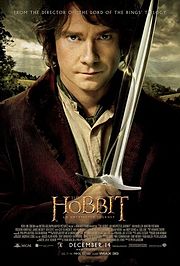
The Hobbit: An Unexpected Journey (2012)

Director: Peter Jackson
Genre: Adventure, Fantasy
Rating: A-

I wasn't sure whether I was going to like this movie or not going into it - I've never been a huge Lord of the Rings fan, but when I read The Hobbit (something like 15 years ago) I really did enjoy it. I was sure it was going to be good, but I didn't expect to be amazed.  To be honest, that's exactly what happened.  It was good, there were even parts that were great, and it brought my attention to some actors who I doubt I would have ever really noticed without it (notably Dean O'Gorman, who I haven't seen in anything since he was Iolaus in Young Hercules alongside Ryan Gosling), but it didn't really blow me away.  I know, I know, I'm a bad fan of fantasy if I don't love the works of Tolkien, but I don't.

The Hobbit: An Unexpected Journey is the first instalment of a prequel trilogy to the Lord of the Rings trilogy - and if you sci-fi fantasy fans out there don't instinctively cringe when you hear the words "prequel trilogy" I question you.  Set sixty years prior to the events of The Lord of the Rings: The Fellowship of the Ring, The Hobbit tells the story of how the hobbit Bilbo Baggins (Freeman) joined the company of dwarves lead by Thorin Oakenshield (Armitage) on a journey across Middle-earth to reclaim their lost homeland, the Lonely Mountain, from Smaug the dragon.  The dwarves and Bilbo are joined the the wizard Gandalf the Grey (McKellen).  The group comes across Trolls and Orcs on Wargs - the latter who which are hunting specifically for Thorin - Elves, Goblins, and the wizard Radagast the Brown (Sylvester McCoy), who tells of a necromancer at Dol Gulder (played by Benedict Cumberbatch).  Most important of all, however, Bilbo encounters the slimey creature known as Gollum, who carries with him a mysterious ring.

Okay, so I will say this film is fun - in a lot of ways even more so than the Lord of the Rings films were.  There is no dark gloom hanging over our dwarves and hobbit yet, as they embark on an adventure.  They're not trying to save the world, they're trying to kill a dragon and take back a home.  This instantly makes The Hobbit a lot lighter than its predecessor-sequel, a fact that is added to by the way that it's shot - the colours are a lot brighter and cleaner than Lord of the Rings ever was.  There's also a lot more humour here, notably among the dwarves (and their interactions with Bilbo) and Gollum - although Gollum's despair does succeed in bringing a tear to the eye.

I think my favourite part of this movie is the fact that the goal is a lot clearer than in The Hobbit.  I realize that things are about to get a bit murky - what with the ring, and the necromancer, and all - but The Hobbit sets out to be a film about dwarves and a hobbit going to a mountain to fight a dragon, and in the end that's what the series is - or should be - about.  There's other stuff going on too - the ring, the necromancer, the orcs - but the end goal is clear.  You don't feel like anyone is about to stab someone in the back or anything - however unlikely this company is, and however much they might not always like each other, you never feel that they're going to kill each other.  Or at least, not yet.

The thing that I disliked the most about this film, however, is the way it tries to tie into the original series and, more importantly, the way that it utilizes the source material - and strays from the source material.  I might not be the biggest Tolkien fan, but I really don't like seeing people try to add to a work of literature when they make the conversion.  Sure, I understand some things have to get left behind, or merged with other things, but you don't need to add new parts to the story.  The way they did that really bothered me - but then, I suppose if Peter Jackson didn't add to the material, he couldn't as easily make The Hobbit into a trilogy.  I will say that I did really enjoy the way the film used Ian Holm to set up the idea of Bilbo writing a memoir of sorts about his journey, but I don't think that Elijah Wood as Frodo was necessary at all.

Wednesday, 19 December 2012

The Twilight Saga: Breaking Dawn - Part 2 (2012)

Director: Bill Condon
Genre: Fantasy, Romance
Rating: C+

I take back my earlier proclamation of The Twilight Saga: Eclipse being my favourite movie in this series.  Having now seen them all, I can say without a doubt that The Twilight Saga: Breaking Dawn - Part 2 is my favourite. It's the most dramatic, the best acted, and really the most solid film in the series.  There's still a lot that's a bit ridiculous, but it's solid.  You can also kind of tell that they've really put a lot of money into this one,  especially in regards to the special effects.  The cast really don't look like they're covered in pancake makeup anymore, the wigs look better, and so on.  I do question some of the outfits - and how turning into a vampire gave Kristen Stewart fake eyelashes - but it's a lot better than the earlier films.

Breaking Dawn opens with Bella (Stewart) having changed into a vampire and going on her first hunt with husband Edward (Pattinson).  Bella must adapt to being a vampire and the pair must adapt to being parents (while also still being newlyweds), to their human-vampire hybrid daughter, Renesmee, nicknamed Nessie (played first by a creepy CGI baby, then by Mackenzie Foy).  Early problems that arise are werewolf Jacob (Lautner) having imprinted on Nessie, Bella's feeding, all the sex that they can now have, Nessie's rapid aging and the potential consequences of it, and what to tell Bella's father, Charlie (Burke).  Then fellow vampire Irina (Maggie Grace) sees Renesmee and, assuming that she is an immortal child, tells the Volturi that the Cullens have broken the vampire law.  Alice (Greene) sees a vision of the Volturi coming to punish the Cullens, setting them on the path to trying to stop them.  The family head travel throughout the world in an attempt to gather up enough witnesses to prevent the Volturi from simply massacring them all.  Then Alice and her lover Jasper (Rathbone) disappear, leading the Cullens to believe that it means that they are doomed to die.  The question is, whether or not they can survive the meeting with the Volturi.

So, yeah.  A lot of the earlier cheese of the films is gone.  The general problems have been resolved, and things that are silly have either been largely dropped or so accepted so as to no longer really be an issue.  One of the things that I liked most about this film was that Edward really chilled out here.  There's no conflict between him and Bella, there's no whining about her being a human (because she isn't), or about him needing to protect her (because he doesn't), or what how.  For the first time the two are treated as equals.  There's also absolutely no conflict between Edward and Jacob; the two are completely on the same side, which is great. It makes the plot so much less annoying.

The cheese that does remain is funny.  Bella as a vampire? Funny.  Bella learning that Jacob imprinted on Renesme and nicknamed her Nessie? Hilarious. There's more to it than just that, and it's all great.  This movie is probably the funniest of the series, and intentionally so.  The many other vampires that they introduce here are far better than the ones that we've gotten used to over the course of the series.  There are so many, it's hard to pick a favourite - I think the Russians, Vladimir (Noel Fisher) and Stefan (Guri Weinberg), although Lee Pace's Garret is also great.

Another thing that I really liked is the opening and closing credits.   I thought the opening credits were really well done in general, and nicely fit the theme for the series.  In particular, I enjoyed how the cast names changed from red - representing the human - to white - representing the vampire.  I thought it was a cool touch.  For the closing credits I actually really enjoyed how they credited people from all five movies - Bella's human family and friends, the Cullens and their vampire friends and family, the Volturi, the Pack and other Quileute people.  I thought it was a nice touch, a "these are the people that helped us get to this point."

The rest of this contains spoilers.  My absolute favourite part of the movie, and my least favourite part, is the actual face off with the Volturi.  Michael Sheen is probably one of the best actors that has appeared in this series, which says a lot because really there are some good actors here.  The ending in the books is kind of lame.  There's a point in the conflict when Alice returns and shows Aro a vision, then Aro and the Volturi back down and the conflict is resolved.  There's no fighting, no deaths, no nothing.  In the movie, however, we see Alice's vision, without realizing that it's a vision.  As a result, there's this epic battle full of great fight sequences and a lot of deaths.  There's a lot more emotion in this one scene than in the rest of the series.  The thing that got me about the Twilight books is that it never made me cry.  There was no sacrifice in the books.  This apparent ending, however, is so drastically different from the books that as people start dying I realized just how emotionally invested I had become and how attached I was to the characters.  There was also a moment when it happened that I couldn't help but think that the ending of the movie was going to be a giant fuck you to author Stephenie Meyer, who has said (about The Host) that she's not sure how she feels about killing off characters.  There's a lot about these movies, especially in the promotions for it, that make it rather apparent that the cast don't really like the books or movies themselves and for a moment I really felt like this was the cast and crew's way of really vocalizing that thought. It ended up not being that, but for a moment as we see Alice's vision and don't realize that's what it is I was thinking that this ending was so much better than the one Stephenie Meyer wrote. It didn't end up being the ending, but it was fun while it lasted.

Monday, 17 December 2012

Harry Potter and the Order of the Phoenix

Author: J.K. Rowling
Genre: Fantasy
Rating: B

Following the disastrous results of the Triwizard Tournament, Harry Potter was sent back to his Muggle aunt and uncle's home.  All summer he waited anxiously for news of Voldemort's return, growing more and more desperate and aggravated as the days passed by and he began to feel more and more shut out of the wizarding world.  Then Dementors arrive and attack him and his cousin.  Suddenly, Harry is faces being expelled from Hogwarts, forced to face a trial at the Ministry of Magic, and it is revealed that few in the Magical world believe him anymore.  Those who do believe him, and Dumbledore, are in the Order of the Phoenix, a secret organization that operates against Voldemort.  While Harry is able to successfully avoid expulsion and prison, things are not as they used to be at Hogwarts.  He is the subject of gossip and disdain from his peers, and is in constant opposition with the new professor of Defense against the Dark Arts, Dolores Umbridge, a woman who is clearly working for Minister of Magic Cornelius Fudge against Dumbledore.

There are elements of this book that are absolutely awesome.  I love the Order, Dumbledore's Army, Kreacher, the emergence of Weasley's Wizard Wheezes.  There are so many really great aspects of this novel, that just add to the world of Harry Potter and make it even better.  Really in the long run, Harry Potter and the Order of the Phoenix is great because of everything in it that isn't Harry himself.  I think my favourite elements of this book are actually the DA and the growth of Neville Longbottom.  This is the book where the secondary characters really start to take form of their own and exist beyond the mind of Harry Potter.  We've seen how Harry, Ron, and Hermione have been growing all along, but we haven't seen how Neville, Ginny, etc, have been doing so - Order of the Phoenix shows us this through the furthered interactions that Harry has with the Weasleys and the development of the DA.  We also really get to see this calling for teaching that Harry has.  He gets to show others how to do the things that he can do - he gets to expand their knowledge base and in doing so he also expands his knowledge base.  Oh, plus, as much as I hate Umbridge her constant presence places this huge amount of strain on Harry throughout the year, and thus throughout the book, ensuring that the plot is always present.  Voldemort is in many ways a rather secondary threat here, Umbridge is the big focus.  In a manner, it kind of reminds me of the Little and Big Bads of the Buffyverse.  Umbridge is definitely the Little Bad, but she gains more of a focus throughout the course of the book.

The thing that I really disliked about this book, which rather disables it as a whole, is Harry.  As much as I understand what he's going through, this is the book where he really becomes a whiny, annoying teenager.  It makes it hard to like him.  There's a point in the book where I found myself wishing that it was being told from a different perspective, because I didn't care about Harry's self-sacrificing, self-hating, hating the world, attitude.  There are moments when it's great - like when he locks himself in his room out of fear that he's the weapon being used by Voldemort - but for the most part it is less than great.  We're often told that the greatest power that Harry has is his ability to love, but in this book all we see is hate.  He hates others, he hates himself, others hate him... It's a very ugly mess and given just how long the book is makes things a bit dull after awhile.

Thursday, 13 December 2012

The Twilight Saga: Breaking Dawn - Part 1 (2011)

Director: Bill Condon
Genre: Fantasy, Romance
Rating: C+

These movies somehow seem to just get more and more ridiculous with each passing film.  The thing that I really like about The Twilight Saga: Breaking Dawn - Part 1 is that it does away with the ridiculous melodrama of the love triangle and introduces new ridiculous melodrama.  The new melodrama is still really rather lame, but it's such a relief to be done with the love triangle bullshit.

Breaking Dawn opens with the prelude to the wedding of the human Bella Swan (Stewart) and her vampire lover Edward Cullen (Pattinson).  Werewolf, best friend, and former would-be-lover Jacob Black (Lautner) is very upset about this and laments the impending loss of Bella's humanity - and is outright pissed off when he realizes that Bella and Edward intend to go on their honeymoon before Bella is turned.  This honeymoon plan turns to be rather screwy for them all, as during it Bella gets pregnant with Edward's baby.  The rest of this movie then deals with the vampires and werewolves each dealing with the consequences of this impending birth.

Soo, yeah.  Ridiculous melodrama.  But somehow it's funny ridiculous melodrama.  Once again, the cast seems to know that the basic concept of this movie is silly and they just go with it.  Once again, I'm going to say that they're all better actors than people give them credit for for not laughing half the time in this movie.  Especially the scene where Bella discovers she's pregnant.  The fact that they were able to play that straight makes them far better actors than we like to give them credit for.

The real strong part of this movie is the fact that it moves on from the love triangle while maintaining that continuity.  Jacob is still in love with Bella and he still makes it clear that he loves her and he will always protect her, but he is no longer trying to win her.  He knows he's lost and he's accepting that, or at least trying to.  There's no more Bella being annoyed with him for hitting on her, or struggling to make a decision between him and Edward.  There's also the fact that Edward seems to have truly accepted Jacob as a part of Bella's, and by extension his, life.  I kind of felt like this whole plot lasted at least a movie longer than it needed to, so I was happy to be done with it.

The weak point in this movie is how they tried to draw suspense out of things that I don't think were really all that suspenseful.  There is suspense in this movie - especially pertaining to the likelihood of Bella's survival and what this child is going to be like - but what they try to make suspenseful isn't.  Like whether or not drinking blood is going to be helpful to Bella.  Not suspenseful, don't cue the drawn out sequences and music.  You know what was suspenseful?  The way the movie ends - at least until you see the trailer for the next film.  That kind of killed that.

Thursday, 6 December 2012

The Twilight Saga: Eclipse (2010)

Director: David Slade
Genre: Fantasy, Romance
Rating: C

As weird as it is to say this, I think this is actually my favourite of the Twilight movies.  The plot is still meh, and the acting is still meh, and the special effects and the makeup are still meh,  but the humour has transitioned from being unintentional to... well, I'm not sure how intentional it is and how unintentional it is.  The point is, there is humour in this one.  And action.  And no lame suicide plots.

People are being killed in Seattle, but our friendly neighbourhood vampires are only concerned about how it might affect them.  Likewise with our friendly neighbourhood werewolves.  Alice (Greene) is monitoring the decisions being made by the villainous Victoria (Howard),  as we all know it's only a matter of time before she makes yet another attempt on Bella (Stewart).  Meanwhile, Bella and Edward (Pattinson) are discussing marriage - although both Bella's best friend and would-be-lover Jacob (Lautner) and her father Charlie (Burke) are dead set against the relationship between the two, although for different reasons.  Oh, and once shit does start to go down the friendly neighbourhood vampires and friendly neighbourhood werewolves try to work together.

So, yeah.  The thing that works about this movie is the humour.  My favourite scene in this entire movie - possibly the entire series - is when Bella and Charlie have what is the most awkward sex talk ever.  That alone made this movie worth watching.  There are other moments like this one that really make me think that the actors are far better than we give them credit for just because they're able to keep a straight face throughout it all.  That's not to say that the acting itself is in any way all that good, but that it's not as bad as we claim it is.  I also do like how the plot moves forward here.  The first two movies were really all about setting things up and introducing us to characters and concepts - vampires, werewolves, the Volturi, etc.  This time round things actually go forward and stuff happens.  There's even a whole epic battle!  It's not all bad!

Not all bad, but still not all that good.  The plot still has gigantic holes, ones that I think if I really tried to wrap my head around and explain I would just end up either confused or pissed off - or both.  I still want to spend most of my time yelling at the characters, or at least the main ones.  The thing about Twilight in general is that the more sympathetic and loveable characters are the ones that don't get as much of a focus.  I love Bella's friends from high school, and Charlie, and even the vampires and werewolves who are not Edward or Jacob.  We get to see a bit more of these characters here, although I know it's not a trend that's going to continue.  The triangle is resolved here, and the next two movies are going to be all about the lovefest and its consequences.  Yay?

Tuesday, 4 December 2012

Thor (2011)

Director: Kenneth Branagh
Genre: Action, Adventure, Comic
Rating: B+

Many years ago a bitter war was fought between the Frost Giants of Jotunheim and the warriors of Asgard, over the future of the nine realms which the Asgardians protect.  Now, in the present, the king of Asgard, Odin (Hopkins), is preparing to adbicate his throne in favour of his son, Thor (Hemsworth).  Before he can do so, however, Frost Giants attack Asgard in order to retrieve the Casket of Ancient Winters, the source of their power, from the Asgardians.  In retaliation, Thor decides to lead an attack on the Frost Giants, accompanied by his brother Loki (Hiddleston), their childhood friend Sif (Jaimie Alexander) and the Warriors Three, Volstagg (Ray Stevenson), Fandral (Joshua Dallas), and Hogun (Tadanobu Asano).  The battle destroys the truce between the two races, and Odin must interfere in order to save the Asgardians.  As punishment, he strips Thor of his powers and exiles him to Earth, although he sends Thor's hammer, Mjolnir, as well, so that if and when Thor is worthy he can pick it up.  On Earth, Thor is found by astrophysicist Jane Foster (Portman), her assistant Darcy Lewis (Dennings), and mentor Dr. Erik Selvig (Skarsgård).  His hammer, however, is found by the local populace, and eventually attracts the attention of S.H.E.I.L.D.  Thor must find his hammer and return to Asgard, before the Frost Giants can take over.

This was a fun movie, as all the Marvel Cinemetic Universe films tend to be.  Thor is, in my opinion, absolutely amazing and clearly worthy of a standalone series - which is something that Marvel seems to struggle in distinguishing at times.  A lot of the Avengers are great, and most of them deserve their own opportunity to shine in the sun, but some don't.  Going into this film, I wasn't really sure about whether I thought Thor was one of those shining characters or not and I really questioned just how he fit into the greater scheme of the universe already established by characters like Iron Man and The Hulk.  In the end, however, I think he really fit well and did a great job of adding to the feel of this series.

The other thing that really worked was Loki.  The two most important characters in this film are the brothers (no offense to love interest Natalie Portman), and they really mesh well.  They both go through transitions in this film and I love how you see where they come from and where they end up.  Part of me would have liked a bit more back story to Loki - it feels almost like he starts this film a few steps ahead of the rest of us, and we're all left trying to catch up (although, Thor does take very big steps).  As for the Thor/Jane relationship... I love how it kind of sneaks up on both of them, even if the audience is completely expecting it the entire time.  Thor has to change in order to be the man for Jane, and it is this change that makes him the man that he needs to be in order to be the god that his father wants him to be.  I'm really looking forward to how this relationship continues to develop in later films - I was actually rather disappointed that she didn't make an appearance in The Avengers, but I do see how it could have potentially taken away from that film.  Either way, I really enjoyed this movie.

Monday, 3 December 2012

Spike (IDW Publishing)

Creator: Brian Lynch, Joss Whedon
Publisher: IDW Publishing
Genre: Fantasy, Drama, Horror, Comic
Rating: B+

I wasn't initially going to review this mini-series, but I decided to do so while writing the review for Buffy the Vampire Slayer Season Eight, simply because it acts as a bridge connecting Angel: After the Fall to Season Eight.  I'm not entirely sure yet if I'm going to do stand-alone reviews of the other mini-series within the After the Fall franchise, or the Buffy the Vampire Slayer comic franchise either, but Spike is special.

Initially Spike was conceived as a longer series, but the move to Dark Horse Comics changed things up a bit, limiting this run.  Instead, what we have is a eight issue arch, placing Spike and a new crew in Las Vegas, once again in opposition to regular villains, lawyers Wolfram and Hart and mentally unstable vampire Drusilla.  There's a lot of discussion about Spike's soul in this series, which is always an interesting topic, and by the end of it Spike has acquired a space ship space (that resembles a penis in this series) full of space bugs, who become his next new crew.

I really thought this series was a lot of fun.  It was snarky and dark and returned Spike to the (mental) place where I loved him.  There's no Buffy, but Spike needs to grow a bit on his own - we saw that in season five of Angel.  This arch is also fun and nicely introduces new characters - like Season Eight it also reestablishes old favourites, like Drusilla.  I love Drusilla and I doubt I will ever get tired of them bringing her back to screw with the day once again.

Most importantly, though, I really like how this arch connects After the Fall to Season Eight.  My biggest problem with Season Eight is the fact that it's hard to place just when that all is happening, this arch tries to establish a bit of continuity between the two series that I think is going to be continued (at least a bit) in Angel and Faith and Buffy the Vampire Season Nine.  Or maybe I'm just being a bit too optimistic, seeing as I've only read about ten issues of each series.

Buffy the Vampire Slayer Season Eight

Creator: Joss Whedon
Publisher: Dark Horse Comics
Genre: Fantasy, Drama, Horror, Comic
Rating: B-

Set some time after the completion of both season seven of Buffy the Vampire Slayer and season five of its spin-off Angel, the comic series Buffy the Vampire Slayer Season Eight shows us how Buffy Summers and the surviving Scoobies manage following the defeat of the First Evil and the creation of a multitude of slayers.  Slaying has become a secret, paramilitary organization helmed by Buffy, and is now starting to draw the attention of governments. A new organization, Twilight, is gaining prominence and directly threatens the slayers. This season brings an introduction of new characters, primarily in the form of slayers, and a return of old favourites (and not-so-favourites).

The thing that I really disliked about this season was that it was really hard to place in time.  You know from the start that it's set after the conclusion of the TV runs of both shows, but it's not as clear, at least from the start, where it's occurring in relation to the comic Angel: After the Fall and its many mini series.  This is a problem that's never really entirely resolved, a disappointment given as it becomes a bit integral to the plot later on - especially as characters cross over from Buffy to Angel and back again.  This is a problem that, to the best of my knowledge, never really gets resolved, although it ceases to be an issue (or as much of one) in the next editions of this story, Buffy the Vampire Slayer Season Nine and Angel and Faith, along with their mini series, all of which are under one publishing house and presumably one direction.

There are really kind of two arches here, as is common within Joss Whedon works.  There is both a Big and a Little Bad, and for the purpose of remaining relatively spoiler free, I'm not going to identify who (or what) either is beyond the existence of Twilight.  If you really want to know, check out the Buffy Wiki.  With this, two arch idea in mind, I'm going to say that for the most part I really liked the first arch and the Little Bad, while for the most part I kind of disliked the second arch and the Big Bad.

For the first arch, there's the whole feel of the world of Buffy, even though it's in a completely different setting. We see Buffy trying to step into this leadership role that is so much bigger than anything she's done before and really succeeding at it, while also still coming up against a lot of the same struggles that she's dealt with for many seasons now.  You can really see that she's struggling. There are a lot of ties to the way the show was, especially in the earlier years, which I loved.  In particular, both the Slayers and the organization of Twilight really reminded me of season four's Initiative.  There were a couple of more stand-alone episodes that didn't seem to work as well as the more overall arch, notably the Japanese vampires who stole Dracula's powers, although I did enjoy the return of Dracula.  This wasn't too bothersome overall, though, as I don't think Buffy's ever really been known for its stand-alone episodes - no one cares about Inca the Mummy Girl or the hyena possessed students who ate Principal Flutie (the exception here, is "Once More with Feeling" which was just awesome).

The second arch, where timing becomes a bit more important, is a lot less well done.  I liked the overall fight and the motives and methods of our heroes - I even really liked the conclusion of things.  I didn't really like some of the themes, though, or how some things played out after the revelation of Twilight.  Some of the themes here are ones that played into the themes of the series as a whole, which I liked, while others seemed to violate the rules of the world, which I disliked.  These rule breakages seemed to be waved away with a bit of a "it's magic" bullshit, which I tend to dislike as well.  I had to suspend my disbelief a fair bit in this arch, which I don't like.  There's just... this lack of consistency, I guess.

What I'm a bit undecided about here, is regarding the relationships this season.  There are a few here: the ongoing Angel/Buffy/Spike triangle, Willow/Kennedy, Dawn and Xander's love lifes (both which see the introduction of new characters), and Buffy's imposed stint of celibacy.  To start, the likes.  I really like what they did with Willow and Kennedy.  While I'm not the biggest Kennedy fan, I appreciate the fact that the writers respected Tara's death and haven't caved into the demand to get rid of Kennedy and bring her back.  I also like the fact that the two of them struggle and go through ups and downs, because ups and downs (and more downs and sometimes deaths) is what Buffy is about.  I also loved the Dawn storyline, and the fact that we're slowly given the backstory as to just how Dawn became a giant (yes, this is related to her romantic life).  Xander's was cute too.  Xander tends to be rather abused in the Buffyverse, particularly when it comes to romantic entanglements, so every time they introduce a new romantic partner for him I find myself hoping that she's the one and wondering just how it's going to explode.

Now, for the less good.  I have a lot of mixed feelings regarding the triangle.  In general, I have no problem with its continued presence within the series, and I really understand the perspectives of both Buffy and Spike.  On the one hand, Buffy will always view Angel as the first love of her life, the good guy, and the guy who got away.  At the same time, she also views Spike as the guy who's been there, especially in the last few seasons when she's been at her lowest, but he's also the guy who's hurt her.  I don't doubt that she really does love him, as revealed in the finale of the TV series, but that love is a convoluted and confusing thing.  She's not yet at a place where she can really accept and embrace that love, and might never be there.  I don't know if they'll end up together in the end or not, or if they'll end up both alive in the end, or both dead, or what - it being Joss, I kind of suspect that Buffy, Angel, and Spike will all die before this triangle is ever really resolved.  The point is, for Buffy there is always that love for Angel, and I think there is also that love for Spike, regardless of who she's with - be it Angel, Spike, or someone else entirely.  For Spike, there is also always Buffy, regardless of who he's with.

At the same time, Angel is not in this situation.  Buffy is not always the one for Angel, in fact I don't think she's been the one for him for some time now.  Within the continuity of Angel he has moved on.  He's found another great love and it is for her that he longs, not Buffy.  After a point, when Buffy was brought up within Angel it was more and more with either nostalgia or out of a desire to oppose Spike; this is particularly prominent in season five, when Spike joins the cast.  When he enters into the Buffy world, however, any development of the character in Angel appears to be discarded - which really, serves as a slap in the face to his relationship with Cordelia.  For me, this really becomes clear in After the Fall, when Angel is broken and thinks he's dying - it is for Cordelia he calls for (inadvertently naming his male dragon after her), not Buffy.  To have him fall back into the "let's be with Buffy" thing here just seems like an insult to that character development.

Thursday, 29 November 2012

The Twilight Saga: New Moon (2009)

Director: Chris Weitz
Genre: Fantasy, Romance
Rating: D

Remember how I didn't like Twilight?  Somehow, the followup to it, The Twilight Saga: New Moon (because evidently the viewing public is incapable of determining that something is a sequel to another movie unless there's words that are the same) succeeds in making Twilight look good.

The run down: Edward (Pattinson) and Bella (Stewart) are living happily ever after, minus the whole her whining about being human and him refusing to turn her into a vampire because, really, why would you take the advice of the guy who tried to kill you in the last movie? Bella is particularly whiney about the issue because she's turning eighteen, which is one year older than her eternal lover, except not really.  At a party for her at his family's house, however, her mortality becomes all too aparent when she gets a papercut, causing a blood frenzy, that is only made worse when Edward throws her into a wall.  So Edward decides to break up with her and leave, taking his entire family with him and putting Bella into a depression that lasts forever.  Then she reconnects with Jacob (Lautner) and begins to seek out danger and adventure - all in a way to get glimpses of the Edward inside her head.  Something's wrong with Jacob and his tribe however, and it's only a matter of time before Bella comes out of her depression long enough to figure it out.  Also featured are the Volturi, the rulers of the vampire world, each of whom has great power.  Their leader is Aro (Sheen), and he is joined by Marcus (Christopher Heyerdahl) and Caius (Jamie Campbell Bower).  Their guards include Jane (Fanning) and her brother Alec (Cameron Bright).  Oh, and Victoria (Lefèvre) is back for revenge.

I hate the premise of this movie.  I realize that instantly makes me biased, but I hate it.  I hate that Bella is all whiny about being made into a vampire - honestly, I think I prefer vampire/human romances where the human doesn't want to be a vampire, or at least thinks about the consequences of becoming one a bit more, and isn't just all "I don't want to look older than you".  I hate that no one seems to want to point out the fact that it was James (Cam Gigandet) who gave her this idea in the first place.  Since when is taking advice from the bad guy a good idea?  I actually kind of liked that Jasper (Rathbone) goes into a blood frenzy when Bella gets a papercut as it makes sense in this world - it's kind of lame overall, but I like it - although I do question Edward's protectiveness.  Seriously, throwing her into a bookshelf is not going to help the situation.  Don't want your human girlfriend to be eaten by your vampire family? Don't throw her into a bookshelf.

What I hate most of all, however, is Bella's reaction to the breakup.  She literally goes into a depression for months on end following Edward leaving her.  I get the whole post-relationship depression, but she takes it to an extreme.  Granted, she had already basically given up her life for Edward before hand, so she didn't really have one to cling on to after he was gone... Yeah. Did not like it.  I also don't like Edward's behaviour overall.  First of all, he really seems to encourage her in her complete abandonment of her friends - something that becomes more pronounced as the series continues and the issues with Jacob become more pronounced.   I'm not saying that I disagree with Edward's feelings towards Jacob, I'm saying I don't like Edward's treatment of Bella's other friends, or Bella's treatment of them either.  As for Jacob... fuck, Jacob needs to grow up.  I get that he's a kid, and the youngest of the characters too, but his feelings and what not get annoying really fast.  There is a point when your attempts to hit on your best friend turn from heavy flirting to sexual harassment.  Remember boys, if she says "no" she's not meaning "try harder."

Tuesday, 27 November 2012

Zardoz (1974)

Director: John Boorman
Genre: Fantasy, Sci-Fi
Rating: D

"The gun is good. The penis is evil. The penis shoots seeds, and makes new life to poison the Earth with a plague of men, as once it was, but the gun shoots death, and purifies the Earth of the filth of brutals. Go forth ... and kill!"

Thus begins the classic cult film Zardoz.  In the year 2293 the Earth is inhabited primarily by a people called the Brutals, who are ruled without realizing it by the Eternals.  As the names might suggest, the Brutals live a life of brutality while the Eternals lived a life of ease - a life that lasted forever.  The Brutals, however, don't actually know about the Eternals.  Instead, they are more directly ruled over by a class known as the Exterminators, who worship the god Zardoz.  Zardoz appears to them in the form of a giant flying, hollow stone head, where the Exterminators deposit grain in exchange for guns.Enter the Exterminator Zed (Connery) hides in the head of Zardoz, where he's brought to the Vortex - the community of the Eternals that is protected from the Brutals by an invisible force-field.  Here Zed meets two Eternals, Consuella (Rampling) and May (Kestelman), and begins to figure out this new world around him.

And the entire time, Sean Connery looks like this.  Except for when he's wearing a wedding dress.  I kid you not.  That bit is possibly the best moment of the entire film, Sean Connery running around the Vortex in a wedding dress.  The other costumes are rather quesitonable too... and when it comes down to it, all I can do is hope that I'm not alive to see the future inspired by 70s fashion.

The plot for this movie is laughable at best.   I spent most of it wondering just what the hell was going on, and even when I had it figured out I still wasn't sure.  The plot overall was a lot like the costume; it's weird, it's confusing, it's disturbing and distressing, and yet for some reason you can't seem to look away.  It's not really good... but I'm not too sure if it's really bad either.  Disturbing.  That's the word I'm going to go with.

Thursday, 22 November 2012

Twilight (2008)

Genre: Fantasy, Romance
Rating: C-

Where to begin... These are not good movies.  I'm not entirely sure how much of that is the fault of the movies themselves and how much is the fault of the source material upon which they're based, but it's many degrees of not good all around.  I will say this, though; they do kind of get better as the series goes on.  They never achieve a good state, but they get better - or at least, up until The Twilight Saga: Breaking Dawn - Part 1.  I can't judge Part 2 as I haven't seen it yet.

For those lucky few who have somehow managed to avoid learning what Twilight is about, here's a quick recap.  Bella Swan (Stewart) moves to Forks, Washington, the wettest place in the continental United States, to live with her dad, Charlie (Burke).  There she meets Edward Cullen (Pattinson), a mind reading vampire who she falls in love with.  Edward and his family (patriarch Carlisle Cullen (Facinelli) and his wife Esme (Reaser), the psychic Alice Cullen (Greene) and her partner Jasper Hale (Rathbone), and Emmett Cullen (Lutz) and his partner Rosalie Hale (Reed)) are all what they call vegetarians, and do not heat human blood.  Most of the movie passes by with this being the only real plot point, but then the Cullens, Hales, and Bella meet nomadic, human blood drinking vampires Laurent (Gathegi), Victoria (Lefèvre), and James (Gigandet).  James is a tracker and after a confrontation with Edward becomes infatuated with the idea of killing Bella.

Once again, what to say... Okay, so there are three major problems with these movies.  One is the general script, the second the general acting and overall casting, and the third the general make-up.  The script... oh, the script.  I'm going to say this in defense of the movie overall; you can only do so much with a movie when the source material isn't that great.  For all of Twilight the movies' flaws, a lot of them are because of the flaws of the book.  This movie did a lot to stay true to the books, for which I respect.  A few things were omitted, and in such a way that while I don't think it really disabled Twilight, it does fail to set things up for The Twilight Saga: New Moon.  You see this a lot in movies and even in TV, and it really annoys me - if you're basing something on a series of books and planning on continuing the series think about how the cuts made affect later movies or seasons.  It's easy to harp on it in Twilight, but they also do it in Game of Thrones, Harry Potter, and The Hunger Games.

The second big thing here is the cast.  The acting isn't that great, and there are even points when it seems like some of the actors are breaking character, laughing at points that in-character they shouldn't be laughing at.  This isn't really a criticism of the actors themselves, because I don't think it's the flaw of the actors.  I've watched other works of most of the actors and really enjoyed them.  There are some really great actors in this movie, they're just not properly utilized here.  The other problem is the casting in general, which is rather horrible.  It's not enough to hire a good actor, you have to hire an actor that's right for a role.  There are some people who I thought were really perfectly cast - particularly in regards to the humans - but others not so much - particularly in regards to the vampires.  I think one of the biggest problems that Robert Pattinson has in this role is that his American accent definitely isn't a good one (it does get better), making you question why they hired someone to fill in the role of an American when he couldn't do the accent.  Accents are tricky and something that movies in general, not just Twilight, tend to get wrong.  Michael Collins is actually a really good movie, despite the fact that half the cast are Americans doing bad accents, and among the other half is Alan Rickman who doesn't even try to do an Irish accent. Accents are important, people.  The casting problems in Twilight, however, go beyond just accents. There's also the fact that the vampires are all supposed to be these pale creatures (the exception being Laurent, who is black), but for the most part they hired not-exactly pale actors.  The biggest example of this the case of Nikki Reed's Rosalie.  In the books, she's described as this gorgeous woman and Nikki Reed is gorgeous.  The problem is, naturally she's neither pale nor blonde - she's a brunette with a nice tanned complexion that comes from her Jewish, Cherokee, and Italian descent.  So, what do they do?  They slap what looks like pancake makeup and a horrible wig on her.  Nikki Reed isn't the only one that they got wrong here, although I do find it interesting that she's of Cherokee descent, while Taylor Lautner, who plays the Aboriginal Jacob Black, only has "distant" Native American ancestry.  Lautner's role immediately prior to Twilight was as Eugene Levy's son in Cheaper by the Dozen 2.  Don't hire a non-Aboriginal to play an Aboriginal, it's just an insult, especially as there are plenty of Aboriginal actors out there.

But, let's go back to the pancake makeup and bad wigs.  A huge part of what makes fantasy in general so great is the special effects.  The purpose is to take you out of the real world and into this fictional one, no matter how based-in-reality it is you need to have good special effects, especially when you're expecting to be a blockbuster.  The makeup here is horrible, absolutely horrible.  There are a slew of bad wigs, bad dye jobs, and bad attempts to make the not-pale actors look pale.  It's just bad all around.  I commend Twilight for attempting to stick to the source material a lot, but in regards to the makeup this really hinders the movie.  You want to have not-pale actors?  Then give up the pale aspect of the character.  Ditto with the blond.  Don't just give them a really bad dye job.  Yes, vampires are usually pale, but this is the 21st century.  We're allowed to update the myth - Stephenie Meyer does a lot to update this myth in general, and pale skin is not important to the plot.  The worst attempt at this is in the case of Edi Gathegi, who they attempt to make pale despite his being black.  It's just all kinds of bad.  But then, so is this movie.

Monday, 19 November 2012

Harry Potter and the Goblet of Fire

Courtesy of Wikipedia
Author: J.K. Rowling
Genre: Fantasy
Rating: A

New adventures are coming to Hogwarts, just in time for Harry Potter’s fourth year.  The school is playing host to the Triwizard’s Tournament, a competition between champions representing the three great European schools of magic, Hogwarts, Beauxbatons, and Durmstrang, as determined by the Goblet of Fire.  Traditionally there are only three champions, one for each of the schools, and with the revival of the championship a new rule has been introduced stating that no one under the age of seventeen may enter their name as a champion.  This is all changed, however, when four names come out of the Goblet; Cedric Diggory, Fleur Delacour, Viktor Krum, and Harry Potter.  At first, only Hogwart’s new Defence Against the Dark Arts Teacher, ex-Auror and extremely paranoid Alastor “Mad-Eye” Moody, and Albus Dumbledore seem to believe that Harry did not put his name into the goblet and the school is divided between those few who support Harry, and are primarily Gryffindors, and those who think he is attempting to steal the glory from Hufflepuff Diggory.  As Harry begins to face his challenges one begins to wonder just who has a desire to hurt Harry.

Harry Potter and the Goblet of Fire is the book where Rowling really succeeds in quickly introducing the main plot of the story and staying with it throughout the entire novel.  The first chapter sets things up really nicely and the events that happen to Harry during his summer each have an effect on things that happen once school starts up again.  The storytelling here is becoming a lot more concise, ironically while also becoming longer.  The fourth book is almost as long as the first three books combined, and by series end is the second longest book.  The way this works out in Goblet of Fire is that the first overt sign of the complexity of the world of Harry Potter.  There have been other smaller signs of it previously – the first example being the deluminator in the first chapter of Harry Potter and the Philosopher’s Stone, the second being the casual reference to Sirius Black and the less casual reference to his flying motorcycle.  The story here is a lot more concise than the earlier books, but there’s also a lot more going on and we really get to see the world in a whole new light.  We’re introduced to the idea of a magical world beyond just Great Britain, meeting out first international wizards.  We also get to see Harry watch Quidditch for the first, and really the only, time.

In addition to the size of the book, the reader of the book also grows here.  While previous books all had their dark elements, it isn’t until Goblet of Fire that this begins to become really serious.  We see our first deaths of the series – not including the deaths of Harry’s parents, which we’ve been told about and sort of seen briefly before, but not in its entirety.  With the death of Frank Bryce in the first chapter of the book Rowling shows us that she’s not messing around, a fact that she really continues to emphasis throughout both this book and the later ones.  An idea that is introduced in the previous book, Harry Potter and the Prisoner of Azkaban, is really reinforced here, namely the idea of Voldemort’s followers, the Death Eaters, and the fact that they’re not all imprisoned.  We’ve known for awhile that the world is not just happy go lucky and there are bad people here, but somehow the presence of the Death Eaters really reinforces that idea.  We’re also really shown that the world is not divided into good people and Death Eaters.  While we’ve already met a number of people who might later be put into the category of “not good” without falling into the category of “Death Eater,” this is the first time that it’s made explicit.  Rita Skeeter is by no means a good person, but she’s also not a Death Eater.  In contrast, Barty Crouch Sr. is far from being a Death Eater, but one might also question if he’s exactly a good person, and that’s without going into the whole issue of Ludo Bagman, or some of the other characters introduced here.

One criticism about the book, however, lies within its complexity.  There is a lot that could have happened and would have made more logical sense to have happened.  I love the tournament in general, but Voldemort’s plan in this novel has far too many possibilities for failure and if you think about things too closely it makes you question just why he went with it in the first place.   Yes, there’s the whole idea of “I must kill Harry Potter” and what not, but there are a lot of ways that he could have taken Potter without the more elaborate plot, with a lot more fail safes built into it.  The book itself is based on something that really makes no sense, but… well, it’s still a good story.  Maybe not my favourite in the series, but I still love it.

Monday, 12 November 2012

Harry Potter and the Prisoner of Azkaban

Author: J.K. Rowling
Genre: Fantasy
Rating: B+

It’s back to Hogwarts, and as Harry and his friends return for their third year.  As is customary in these books, both the reader and Harry are introduced to greater elements of the wizarding world, in this case the magic world beyond just London and Hogwarts.  Just before Harry returns to school there is an unprecedented breakout at the wizard’s prison, Azkaban, and the deranged madman Sirius Black is on the loose – and looking for Harry Potter.  In the hunt for Black the guards of Azkaban are let loose, and Dementors come to Hogwarts.

One of the things that I loved most about this book was the fact that it broke down the previous conceptions of the divisions within Hogwarts.  Previously it’s been depicted that good people are not in Slytherin and the best people are in Gryffindor, but here we’re being shown a different perspective of things.  Not all Gryffindors are good, therefore presumably not all Slytherins are bad.  This theme really become ones that captures the series; divisions among peoples and yet the ways that we must also come together.  I love, love, love, love this theme and the ways in which it pops up throughout the series.  Previously, even the more mischievous of Gryffindors have been inherently good, while all the Slytherins we know are bullies.

The title of this book, however, is somewhat misleading. While the crux of the climax is in fact about the Prisoner of Azkaban, the book itself is more about fear and a manifestation of fear itself, the Dementors. I think the book could have easily been titled Harry Potter and the Dementors of Azkaban, although the use of two new words might have been a bit too much – with the word “Prisoner” and the similarity between the words “Azkaban” and “Alcatraz” we can assume that the one is some sort of jail. Point is, this book is more about Dementors and what they represent – both for Harry and the world around him – than Sirius Black and the threat he poses, although that is an important part of the overall story of the series. I really like what the Dementors say about the wizarding world. They pose this very real threat to humans in general, as their presence sucks the joy out of a person and can drive them insane and their kiss can suck the soul out of a human – here Rowling tries to answer the question “what’s worse than death.” They represent fear in itself, but the question that people don’t necessarily think about when confronted with them – but I think Rowling is trying to raise – is what can you make of a government that utilizes such a force? And what happens when that government tries to stop using them, or worse when they stop using the government? This threat is far more enticing, and scary, than the Dementors themselves.

Tuesday, 30 October 2012

The Nightmare Before Christmas (1993)

Courtesy of Wikipedia
Director: Henry Selick
Genre: Animation, Family, Fantasy, Musical
Rating: A

It's almost Halloween, which means that it's officially the time to question whether The Nightmare Before Christmas qualifies as a Halloween or Christmas movie.  I personally like to think both.

Jack Skellington (Sarandon, singing voice by Elfman) is the Pumpkin King of Halloween town, but as of late his heart hasn't been in the scarring people business - he wants something more.  This something more is found after Jack discovers the portal to Christmas Town and decides that this year Halloween Town will do Christmas.  With the help of the town he prepares for Christmas, even going so far as to have Lock (Paul Reubens), Shock (O'Hara), and Barrel (Elfman), kidnap 'Sandy Claws' so that Jack can replace him - although unbenknownst to Jack, the trio deliver Sandy to town bogeyman Oogie Boogie (Page).  Watching it all with apprehension is rag-doll and love interest Sally (O'Hara), who is certain that Jack's Christmas is not going to be a success.

It's no surprise that the best part about this movie is the music.  The songs are simplistic, catchy, and well sung.  Honestly, in my opinion one of the best parts about most Tim Burton films is the Danny Elfman soundtrack, and Nightmare really shines as one of his best.  Some of the songs aren't as good, but most of the music is just iconic of the stylings of this film.  It's a perfect blending of the styles of Burton and Elfman - sadly, for actual director Henry Selick he's kind of left out of the limelight a bit here by the two bigger names.

The next thing that makes this movie great is the world that Burton and Selick have created.  It's beautifully crafted stop motion animation, meaning that everything about it has actually been crafted.  The attention to details and what not isn't just some computer program - I realize that there's more to computer animation than just the computer doing it, but it has a different feel to it.  Somehow, the knowledge that the creations in Nightmare are all actually crafted things makes it feel more real.  You might not be able to have as much going on in the background when you're using stop motion, but what happens in the foreground just has this extra little charm to it - and really, Nightmare doesn't lose all that much of the background either.  The fact that they had about 400 heads for Jack alone says something about the time and effort that went into this movie.

Rounding out the greatness is the fact that it's a movie that does, or at least can, appeal to people of all ages.  It's animated and intended to appeal to a younger audience, but it also works really well as a movie for adults.  I actually hated this movie as a kid because I found it to be too scary, but as I got older and it began to reemerge a bit I really got into it.  It's fun, it's cute, it's dark, but it's also light at times.  It's probably the best thing that's come out of Tim Burton, or at least pretty close.  Definitely the best thing Henry Selick's directed.

Monday, 29 October 2012

Angel: After the Fall (Continuing Series)

Courtesy of Wikipedia
Creator: Brian Lynch, Joss Whedon
Publisher: IDW Publishing
Genre: Fantasy, Drama, Horror, Comic
Rating: C

The problem with the second half of Angel: After the Fall is that it retains all of the problems of the first half, while losing much of the strengths.  Here, Angel: After the Fall ceases to really retain the tone of the earlier series, but becomes increasingly confusing.  One of the things that I love most about Joss Whedon in general is the humour, even if it’s something that makes you stop and scratch your head for a moment or feel bad because what you’re laughing at shouldn’t be funny.

Here After the Fall embarks on life-post Hell.  Everyone is trying to regroup and reconcile post the trauma that they’ve been through, without having actually lived through due to the tricky nature of time travel, and the world of magic and demons has been fully revealed to the people of L.A.  Throughout this arch the issue of humanity is approached repeatedly, as is the issue of how to make amends and overcome past deeds – which I have to admit relates really well to the overall theme of Angel the series.

The big problem that I had with the first half of After the Fall was that the art isn’t consistent, a problem that pops up once again in this half.  I actually really liked the art at the start of this half, but then that arch finished and things changed and once again I was left questioning who was who and what the hell was going on.  Making things worse is that there is a lot less overall continuity here, and many of the storylines of different arches are pretty much dropped at the end.  There seems to be less continuity among the characters, making the big reveals to be just all that much more confusing.  Another big issue that I had was that characters are introduced or reintroduced, then forgotten about.  I really did like how Nina and Kate returned to the series, but they seemed to be forgotten about midway through – similarly Gwen returns, then disappears.  This happens as well with main characters, and while this is sometimes covered by little miniseries that occur alongside the greater arch of After the Fall, the whole thing gets rather confusing.  Perhaps I was just missing the cues within the individual comics that a miniseries was coming up, but at times it really appeared as though I was reading a series that had crossover episodes with another show that I hadn’t watched yet.

The other problem is that a lot of the humour is really gone. The show worked really well as the opposition of two forces; usually Angel against someone else, and most notably in the final season Angel against Spike. The dynamic of the two souled vampires was one that in my opinion really saved the show (even if it didn’t go so far as to actually save the show), and is one that was really lacking in the comics. A lot of the time either Angel is gone, Spike is gone, or they’re both gone, and we’re left questioning where they are, what’s going on, and why is this so dark and bleak. I can do dark and bleak, but I like Joss because it integrates both the dark and bleak with the light and humourous really nicely. This is lacking here.

Another note; I really did like how this arch made reference to the many people that Angel has lost, both in terms of character deaths and actor deaths. I missed Lorne in the second half of the series, although I really respect the decision to not use him following the death of Andy Hallett I don’t think they did enough to explain his absence. There’s a shot later on in the series that shows all the Angel dead, with Wesley, Cordelia, Fred, and Lorne each being pictured (I can’t remember if Doyle was also shown), although Lorne’s death is never explained or even stated – it isn’t clear in this continuation if Lorne is still alive and just elsewhere – continuing his estrangement from the Angel crew following the demands Angel made of him in the finale – or if he’s died off screen.  Through the use of Wikipedia I was able to discover that there was a special Lorne tribute comic, which I love, but this wasn't explained in this comic, which I dislike.